The translation below is a quick effort by a non-professional volunteer, Azadeh Ensha, whom I would like to thank. As soon as an authoritative version is available I will post it or a link.
Article follows:
15:51 GMT Tuesday 4 September 2007
Kian Tajbakhsh will be freed
Kian Tajbakhsh, a social science researcher, who was accused of undermining national security and spying and who was arrested in Iran will be freed on bail.
State television of Iran quoted Hassan Hadad, prosecutor for the national security court in Tehran, reported that the investigation of the special court into Mr. Tajbakhsh is ongoing, and that after completion of the investigation, he will be released on bail.
Mr. Tajbakhsh, a social science researcher and a consultant to the American Organization called Open Society, which is related to George Soros Foundation, was arrested about four months ago and accused of activities and propaganda for spying and espionage for foreign powers.
A few days after news of his arrest was made public in the Washington Post on 29 May, Alireza Jamshidi, a spokesman for the Judiciary in Iran, confirmed his arrest in a press conference in Tehran.
The spokesman for the Judiciary said about Mr. Tajbakhsh, "This Iranian national is temporarily arrested because he is accused of having activities against the security of the country and he was active in propaganda and spying for foreigners."
Mr. Tajbakhsh is 45-years-old. From 2004, he was working with the plans of International Bank for Iran and he was an active consultant for some of the Iranian governmental organizations. His expertise is public health and urban problems.
A while back, Iranian television program under the title of "In The Name of Democracy" broadcast that Mr. Tajbakhsh, Haleh Esfandiari and Ramin Jahabegloo explained their activities separately.
In this program, Mr. Tajbakhsh said he was working for the Soros Foundation in three different issues concerning Iran. One was open programs, the other was culture and organization making and the third was a long term program to introduce the point of view of the Open Society Institute to Iran.
Owing to his expertise in urban development, said that he was giving Soros Foundation ideas in the area of social and cultural changes in Iran, he tried to connect people of the foundation with people from Iranian institutions and also to organize plans that were not necessarily in his line of expertise.
The Soros Foundation is an institute which is close to the Democratic party in America and Kian Tajbakhsh in part of his talk on television said "that the reason that the American government gave permission to Soros Foundation to have activities and projects in Iran means they have a united approach to Iranian affairs in spite of their differences between Soros Foundation and the Republican party of Mr. Bush."
Haleh Esfandiari, the other Iranian-American researcher, who was arrested at about the same time as Mr. Tajbakhsh on similar accusations, was freed on the 30th of Mordad and left Iran on Monday, the 3rd of September. Also, it's been reported that the passport of Parnaz Azima, the Farda Radio broadcaster who was also forbidden to leave Iran for activities against the regime, received her passport back. Shirin Ebadi, one of the attorneys for Ms. Azima, said to BBC Persian that the justice government last night agreed to return the passport of Azima. Mrs. Ebadi said that her client, who up to now was forbidden to leave Iran, is planning to leave Iran, but will return for her trial.
Read more on this article...
Tuesday, September 4, 2007


Kian Tajbakhsh Released, Parnaz Azima issued passport?
I am getting e-mail reports from Kabul and Washington that Kian Tajbakhsh has been released on bail from Evin Prison, and that Parnaz Azima has been issued a passport and will soon leave Iran. I will post again if there is any confirmation.
Update: RFE/RL confirms the news about Azima.
Further Update: BBC Persian Service reports that the spokesman of the national security court stated on Iran state television that the investigation of Kian's the case is continuing (dar juryan ast), but that he will be released on bail when the investigation is concluded. As far as I can see there is no date given. Read more on this article...
Iran War Rollout Starts: Link to Iraq Troop Reductions?
Since my original post on a report of a post-Labor Day rollout of a propaganda barrage for war with Iran, the report has been picked up by quite a few bloggers who usually preface my name with some honorific such as "respectable," "highly respected,""Serious," "well-connected," etc. I think the point they are trying to get across is that I am not a total lunatic. I don't like being in the position of publishing reports with inadequate evidence, but the stakes are too high, so I will risk losing those adjectives. Here's something else:
I posted the first blog on Wednesday, August 29. On the morning of Thursday, August 30, someone who is a professional in handling information called me to recount a conversation from the previous Thursday or Friday (August 23 or 24). In this conversation, someone whose proximity to knowledge of such things is so great that I cannot identify him in any other way, told my interlocutor that President Bush would be inclined to accept suggestions for withdrawing some troops from Iraq and moving as many as possible into more secure bases, as a safeguard against reprisals in the event of a U.S. attack on Iran.
In today's reports from Iraq (see for example the New York Times and the Washington Post) President Bush is quoted as saying, "If the kind of success we are now seeing here continues it will be possible to maintain the same level of security with fewer American forces." The president made a point of visiting and lauding the progress in predominantly Sunni Anbar province, where the U.S. would be more secure from reprisals by Shi'a militias sympathetic to Iran. Anyone who follows political thinking in the Middle East will realize that throughout the region this will be interpreted as confirming a shift in U.S. strategy toward allying with Sunnis to encircle Iran. The British withdrawal from Basra is also said have been accelerated to avoid reprisals on their highly exposed position there.
Meanwhile, the war rollout started on Labor Day with a Newsweek article by Reuel Marc Gerecht of the American Enterprise Institute stating that "War may come, but not because negotiations break down. The likely trigger is an Iranian provocation." He concludes:
Let's see if we start hearing of very grave Iranian provocations.
Final note: from a Cheney-Addington legal point of view, it does not matter if the entire Sepah-e Pasdaran (Revolutionarly Guards) or only the Qods Force is declared a terrorist organization. The Authorization for the Use of Military Force of September 18, 2001 authorized the use of military force by the President not only against terrorist organizations but against anyone harboring them. So if the Supreme Leader Ayatollah Khamenei refuses to hand over the commander of the Qods Force to U.S. custody, there will be a legal casus belli. Read more on this article...
I posted the first blog on Wednesday, August 29. On the morning of Thursday, August 30, someone who is a professional in handling information called me to recount a conversation from the previous Thursday or Friday (August 23 or 24). In this conversation, someone whose proximity to knowledge of such things is so great that I cannot identify him in any other way, told my interlocutor that President Bush would be inclined to accept suggestions for withdrawing some troops from Iraq and moving as many as possible into more secure bases, as a safeguard against reprisals in the event of a U.S. attack on Iran.
In today's reports from Iraq (see for example the New York Times and the Washington Post) President Bush is quoted as saying, "If the kind of success we are now seeing here continues it will be possible to maintain the same level of security with fewer American forces." The president made a point of visiting and lauding the progress in predominantly Sunni Anbar province, where the U.S. would be more secure from reprisals by Shi'a militias sympathetic to Iran. Anyone who follows political thinking in the Middle East will realize that throughout the region this will be interpreted as confirming a shift in U.S. strategy toward allying with Sunnis to encircle Iran. The British withdrawal from Basra is also said have been accelerated to avoid reprisals on their highly exposed position there.
Meanwhile, the war rollout started on Labor Day with a Newsweek article by Reuel Marc Gerecht of the American Enterprise Institute stating that "War may come, but not because negotiations break down. The likely trigger is an Iranian provocation." He concludes:
Washington can try to exercise soft power—through sanctions, resolutions, diplomatic isolation and rougher rhetoric. But the Islamic Republic, especially its radical president and praetorian guard, are accomplished practitioners of hard power. They are unlikely to be overwhelmed by moderate tactics. Instead, they seem set to continue killing Americans in Iraq, waiting to see if and when the United States gives up and run for the exits.Of course the government of Iraq, dominated by Shi'a groups with close ties to Iran, would oppose an attack on Iran. But it turns out that the central government in Baghdad is now irrelevant to success in Iraq! According to David Brooks in the New York Times, "the key Iraqi figures are not in the center but in the provinces and the tribes. Peace will come to the center last, not to the center first. Stability will come not through some grand reconciliation but through the agglomeration of order, tribe by tribe and street by street." The Wall Street Journal reports (from the news side) that:
The new policy is a profound shift away from the Bush administration's original goal of building a multisectarian democracy in the heart of the Middle East. Instead, the new strategy seems likely to lead to an Iraq with a very weak central government and largely self-governing and homogenous regions. Over the long term the goal is to connect these local leaders to the central government by making them dependent on Baghdad for funds. To qualify for U.S. assistance, local groups must pledge loyalty to the central government, though many Sunni leaders who are working with the U.S. complain the Shiite dominated government is illegitimate.So when the central government in Baghdad opposes a U.S. attack on Iran, the administration can still announce success, because of support in Anbar, at the grassroots, where it really counts. If this war happens, we can count on journalists and "experts" traveling to Ramadi on Pentagon-escorted tours to report on Iraqi popular support for the attack on Iran and widespread opposition to the position taken by the "illegitimate," pro-Iranian government in Baghdad.
Let's see if we start hearing of very grave Iranian provocations.
Final note: from a Cheney-Addington legal point of view, it does not matter if the entire Sepah-e Pasdaran (Revolutionarly Guards) or only the Qods Force is declared a terrorist organization. The Authorization for the Use of Military Force of September 18, 2001 authorized the use of military force by the President not only against terrorist organizations but against anyone harboring them. So if the Supreme Leader Ayatollah Khamenei refuses to hand over the commander of the Qods Force to U.S. custody, there will be a legal casus belli. Read more on this article...
Hashemi Rafsanjani Is Back!
In an important development, Ali Akbar Hashemi Rafsanjani, Iran’s former president and the current head of the Expediency Council won in a secret ballot to become the third chair in the history of Iran’s Assembly of Experts for the Leadership (Majles-e Khobrgran Rahbari). This Assembly is currently a body of 86 scholars of Islamic law (mujtahedeen). According to the Constitution of the Islamic Republic of Iran it is tasked with selecting (Article 107 and 111) and dismissing (Article 111) of the supreme leader (rahbar) in case of the inability to perform constitutional duties or determination that from the beginning certain qualifications were not met. Additional responsibilities include the supervision of rahbar’s activities, and promulgation of laws regarding the activities of the Assembly itself.
Hashemi Rafsanjani had received the highest number of votes in the city of Tehran in the December 2006 election for the Assembly but had continued to serve as deputy chair under Ayatollah Ali Meshkini. Meshkini’s death at the end of June opened the floodgate of discussions about who will eventually chair this elected assembly. Speculations abound that there would be a showdown between Hashemi Rafsanjani and the avid supporter of Mahmoud Ahmadinejad, Ayatollah Mohammad-Taqi Mesbah Yazdi.
In reality, however, given Hashemi Rafsanjani’s impressive showing in the December election (he received almost 50 percent more votes in Tehran than the second vote getter) and Mesbah Yazdi’s comparatively poor showing there was really never a match. There was agreement among most Iranian political pundits that if Hashemi Rafsanjani chose to run he would win. The question was whether he would be willing to go for it knowing that his candidacy would spark vitriolic attacks against him and his family in hard-line newspapers and websites.
Well, Hashemi Rafsanjani chose to run, and the hard-line circles went after him with full force in the weeks prior to the closed three-day meeting that began today, even accusing him of lying in his memoir about Ayatollah Khomieni entertaining the possibility of “retiring” the death to America slogan in mid-1980s. Even more interestingly was the fact that Ayatollah Mesbah Yazdi did not even run since he probably knew he would get embarrassingly few votes. Instead in a strange move on the part of hardliners, Ayatollah Ali Jannati, the head of the Guardian Council, decided to run, completely ignoring the conflict of interest that is involved in the head of the Guardian Council, the body that vets the candidates for the Assembly of Experts, running for the leadership of a body whose membership it vets!
The vote was 41 to 33 with 11 abstentions and 1 spoiled ballot. The number of votes received by Hashemi Rafsanjani was lower than the 69 votes he had received earlier in his election as the deputy chair and is certainly a reflection of how divided or contested the Iranian political system is, even among the clerics. But his expected election, despite lower numbers, was still significant precisely because the hardliners had tried so hard to push him out, even going so far as claiming that some of his supporters and friends were going to run against him.
His election is also significant in so far as it should yet again remind everyone that the Iranian system is truly a contested one, admittedly contested among a limited number of people and groups but nevertheless a contested one. Reports of political demise of individuals or political groups should rarely be taken seriously. What should be taken seriously is the competition that exists among relevant political players, making the political game in Iran intense, uncertain in terms of outcome, and open to political comebacks.
Finally his election should also be a reminder about the utter strangeness of the Iranian political system. Hashemi Rafsanjani is now the head of both the Expediency Council and the Assembly of Experts. He is appointed to the former position by Ayatollah Khamenei but as the elected head of the Assembly of Expert he is constitutionally empowered to begin the process of dismissing Ayatollah Khamenei if the latter is deemed unfit to be the leader!! Read more on this article...
A Change of Guard in Tehran
On September 1st, Iran’s leader Ayatollah Ali Khamanei announced a change in the leadership of Sepah-e Pasdaran-e Enqelab-e Eslami (IRGC). Brigadier (now Major) General Mohammad Ali (Aziz) Jafari was given a new star and appointed as sepah’s new commander while Yahya Rahim Safavi who had led sepah for the past 10 years became the leader’s military advisor, occupying a newly created and probably ceremonial position.
Given the recent news about the possibility of the United States placing sepah on the list of terrorist groups, the move led to speculations about it being a reaction to American pressures. Chances are, however, that it had very little to do with the possible designation, the news for which, from what I now understand, was in any case inaccurate as the contemplated designation was apparently regarding the Qods force, a part of sepah that is said to be engaged in operations in Iraq.
Indeed, in response to direct questions in this regard both commanders in separate news conferences suggested that the decision for change was made about two months ago. Safavi went as far as to say that Ayatollah Khamenei simply does not like anyone serving at any position for more than 10 years. The move nevertheless reveals a couple of interesting points about the role of military in Iranian politics which is usually overlooked.
First and foremost is the tight civilian control that exists over the military in Iran. In the past couple of years, since Mahmoud Ahmadinejad’s 2005 election, there has been a lot of loose talk about the increasing importance of the military in Iranian politics. The reality is that sepah (as well as the regular military) as an institution remains under the constitutionally sanctioned tight reign of the leader’s office. And for years Ayatollah Khamenei has taken that job very seriously, rotating leaders and demanding institutional changes depending on perceived needs and circumstances.
This is nothing new. Iran simply does not have a historical tradition of military prominence in the way for instance Turkey has had. This does not mean that since the inception of modern military in the 20th century, various civilian leaders of Iran, particularly when under pressure, have not used the military arm to “take care of the country’s problems,” by bringing “discipline” to the country or building its roads and pipelines. As Masoud Behnoud, one of Iran’s most astute journalists now living in exile, points out in his Persian blog, even during the Shah’s reign many of the tasks seen as too difficult for public institutions or the private sector were handled and managed by the military. As such, under the current circumstances of sanctions and international pressures, Behnoud I think is right to say that it is not the institutional or internal urge by sepah to grab power that has increased its role in Iranian politics and economy but circumstances. Once circumstances change, so will sepah’s role.
In his press conference Aziz Jafari, the new commander of sepah, was totally unapologetic about this predicament. He acknowledged sepah’s economic role in various construction projects, welcomed them, and in fact defended them as part of sepah’s mission, not to make profit, but to build the country. He identified sepah as a “precautionary force at the service of the commander in chief in order to rush to the help of other organizations wherever help is necessary.”
The second point that the new appointment reveals is about the individuals that have come to constitute the core of sepah’s leadership and the role they are playing in contemporary Iran. It is important to understand that sepah is different from Iran’s regular army in so far as it came into being during the revolution as a people’s army. It is constitutionally expected to “guard the revolution and its achievements,” (unlike the regular military which is given the task of “guarding the independence, territorial integrity, and political order of the Islamic Republic), and found its character during the war with Iraq, a war in which Iran was clearly out-resourced and had to rely on tactical innovations to counter Iraq’s technological superiority.
Many of the men who joined this people’s army to fight in the war and ended up being its commanders were very bright university students in their early twenties. Many of them died, some survived but left sepah during or immediately after the war to turn into politicians, diplomats or bureaucrats (of reformist, centrist, or hard-line kinds), and some remained to make sepah a more professional institution with various branches. These men who stayed on are now in their late forties or early fifties and as individuals see themselves as capable leaders who, precisely because of the experience they gained during the war and afterwards, can influence the direction of the country, in the same way, I would say, ex-IDF generals have seen themselves in relation to Israeli politics.
A number of them, like Mohmmad Baqer Qalibaf (the current mayor of Tehran who has presidential aspirations) and Mohsen Rezaie (the secretary of the Expediency Council, also with presidential aspirations) eventually left their military posts and are making their marks as politicians. Other high ranking officers like Mohammad Baqer Zolghadr and Alireza Afshar are now powerful hard-line bureaucrats in the Interior Ministry (which is in charge of internal security as well as conduct of elections).
Others like Aziz Jafari, who is from the province of Yazd and reportedly a good friend of another Yazdi, the former president Mohmmad Khatami, continue to serve in sepah but are playing a critical role in the transformation of the institution itself. A closer look at Jafari’s biography reveals why it is in the continued commitment of people like him, a man reported to be very genial and well liked within sepah, that one must locate the strength of the Islamic Republic.
He was a student at the very prestigious and difficult to get into architecture school at the University of Tehran during the revolution. According to his official bio he was instrumental in the establishment of the Islamic association at his school, was a representative of his school to the university wide association, and “was active in the takeover” of the American embassy. As such, he must have been friends with many others involved in the event who later became prominent reformist leaders (e.g., Mohsen Mirdamadi who is currently the secretary general of the reformist Islamic Iran's Participation Party) or journalists (e.g., Abbas Abdi). He went to war as a member of the basij militia, immediately joined sepah, and “out of the necessities of the war” soon ended up in command positions. After the war he managed to finish both his architecture degree as well as go through the military leadership training programs. Later he became the commander of sepah’s ground forces. It was as the commander of sepah’s ground forces in 1999 that he signed, along with several other sepah commanders, a threatening letter to his friend and the then President Khatami expressing concern about student riots and the latter’s inability to maintain order.
But the job that qualified him for the current leadership of sepah came in 2005 when Ayatollah Khamenei appointed him to be in charge of setting up sepah’s Strategic Center, a center tasked with drawing up a new command structure and military strategy, preparing the country for the changing regional environment and the kind of foreign military confrontation it may have to face.
In his news conference with the Iranian press, Jafari was very blunt about his task. Pointing out that the threats to Iran have changed, he identified sepah’s role as one of deterrence and defense. He also identified it as a “learning organization” that because of its popular roots and organic ties to the population is very flexible in the kind of asymmetrical war – “similar to the one Hezbollah fought against Israel” - Iran needs to be prepared for just in case it is attacked.
His response to a question regarding the recent American threats against Iran was equally blunt:
The enemies have intensified the tune of threats but they should know that an organization such as sepah that is revolutionary and popular cannot be destroyed and they must show more deliberation in their threats…. The presence of the enemy in the region is causing problems for them and every path they take ends in an impasse. I suggest that they end their presence and interact with Islam and countries of the region form afar. This will surely be to their benefit and I suggest that they leave the region as soon as possible.
The appointment of Aziz Jafari seems to be yet another signal that the Iranian leadership takes the American threat seriously enough to prepare for the kind of fight it feels it might have to fight but undoubtedly prefers not to. Read more on this article...
Monday, September 3, 2007
Haleh Esfandiari allowed to leave Iran: Kian Tajbakhsh, Ali Shakeri still in Evin Prison
Robin Wright of the Washington Post reports that Dr. Haleh Esfandiari, Director of Middle East Studies at the Woodrow Wilson Institute in Washington, D.C., was permitted to leave Tehran this morning. Farida Farhi previously discussed this case here. Esfandiari is to meet her husband, Professor Shaul Bakhash, in Vienna today.
The related cases of other Iranian-U.S. dual nationals (Iran does not recognize dual nationality) have not been resolved. Wright reports:
The Government of Iran created a special section of the Intelligence Ministry to suppress efforts at a "soft revolution" funded by the U.S. At the administration's request, Congress appropriated $75 million for "democratization" efforts in Iran, which Tehran of course sees as a complement to the administration's push for regime change. When the intelligence ministry could not find any programs in Iran actually supported by this money (Iranian spies are apparently unaware of how ineffectively and slowly money for such programs is disbursed), they arrested a number of Iranian-Americans, including Esfandiari and Tajbakhsh, who have been openly and legally carrying out activities in Iran with the knowledge and consent of the government for years.
Whatever may or may not be happening in the confrontation between the Ahmadinejad and Bush governments, these people have nothing to do with it, except that they have been working to promote engagement between the two countries for years. We need such people with us now more than ever. Let's hope that the Iranian government will cease treating these innocent people as hostages to its official relations with the U.S. Read more on this article...
The related cases of other Iranian-U.S. dual nationals (Iran does not recognize dual nationality) have not been resolved. Wright reports:
According to the New York Times on August 23, a judge told Kian Tajbakhsh's wife, Bahar Malek, that he would be released in 10 to 15 days (between September 2 and 7) so that he could spend the last month of his wife's pregnancy with her. But such promises have not been honored in the past.New York-based social scientist Kian Tajbakhsh and California businessman Ali Shakeri are in solitary confinement in Evin Prison. Both were picked up in the same three-day period in early May when Esfandiari was arrested.
Parnaz Azima, a correspondent for U.S.-funded Radio Farda, is out on bail of more than $600,000. . . .
The Government of Iran created a special section of the Intelligence Ministry to suppress efforts at a "soft revolution" funded by the U.S. At the administration's request, Congress appropriated $75 million for "democratization" efforts in Iran, which Tehran of course sees as a complement to the administration's push for regime change. When the intelligence ministry could not find any programs in Iran actually supported by this money (Iranian spies are apparently unaware of how ineffectively and slowly money for such programs is disbursed), they arrested a number of Iranian-Americans, including Esfandiari and Tajbakhsh, who have been openly and legally carrying out activities in Iran with the knowledge and consent of the government for years.
Whatever may or may not be happening in the confrontation between the Ahmadinejad and Bush governments, these people have nothing to do with it, except that they have been working to promote engagement between the two countries for years. We need such people with us now more than ever. Let's hope that the Iranian government will cease treating these innocent people as hostages to its official relations with the U.S. Read more on this article...
Sunday, September 2, 2007
Administration's Iran, drug policies endanger Afghanistan
The Sunday Times of London reports from Washington a story I have not seen in any U.S. media: that "the Pentagon has drawn up plans for massive air strikes against 1,200 targets in Iran, designed to annihilate the Iranians’ military capability in three days." The source of this report was Alexis Debat, director of terrorism and national security at the Nixon Center.
Speaking at a meeting sponsored by the journal National Interest, edited by Irving Kristol, father of Weekly Standard editor Bill Kristol Debate stated:
The legal argument to bypass the U.S. Congress has already been floated. As I noted in my DailyKos post:
The Iranian government has been preparing for the possible collapse of the much weakened Karzai government. They have been doing so mainly by providing extensive military and political assistance to the former Northern Alliance, the grouping of commanders supported by Iran, Russian, and India that was funded by the U.S. to occupy the territory vacated by Taliban and al-Qaida fleeing U.S. air strikes in the fall of 2001. Iran denies the charges by the U.S. that it is aiding the Taliban, but it may well be doing so despite longstanding enmity because it now gives a higher priority to creating problems for a U.S. that it sees as bent on forcible regime change.
U.S. officials may be deceived by the illusion of stability in northern and western Afghanistan. If those areas are quiet, it is because Northern Alliance leaders, under pressure from both the U.S. and Iran, have placed a premium on keeping the anti-Taliban coalition together and have only intermittently openly opposed the government. A U.S. attack on Iran may change this calculus. While some northern leaders will try to maintain an agenda independent of Iran, which is not popular in Afghanistan, the region could quickly move out of government control, as it did when these same commanders' calculus changed in January 1992.
The U.S. can have a confrontation with Iran or a chance for some success in Afghanistan. It cannot have both.
On Afghanistan, David Rohde of the New York Times continues his excellent analytic series with a report from Southern Afghanistan showing that the Afghan police and administration have been unable to hold much territory retaken from the Taliban by NATO forces. The background to the weakness of the police goes back to the decisions analyzed in Rohde's previous article: the ideological opposition to "nation building," which led Donald Rumsfeld to refuse President Karzai's request for funding the police.
In the L.A. Times, Peter Bergen and Sameer Lalwani report from Uruzgan province, that "U.S. efforts to eradicate Afghanistan's [poppy] crop are empowering the Taliban by sowing seeds of resentment." They echo the conclusions I presented here and in other posts on this blog. They write, "The U.S. government, in short, is deeply committed to an unsuccessful drug policy that helps its enemies."
Finally, where are the Democrats and sensible Republicans? It's time to amend the Authorization for the Use of Military Force to make clear that it does not authorize a pre-emptive war on Iran. Congress should also stop the policy of crop eradication that is driving Afghans into the arms of the Taliban while actually increasing the size of the opium economy. Congress should shift the funding allocated for eradication to alternative development. At the moment, according to Bergen and Lalwani, in the new U.S. Strategy for Counter-Narcotics in Afghanistan:
Speaking at a meeting sponsored by the journal National Interest, edited by Irving Kristol, father of Weekly Standard editor Bill Kristol Debate stated:
US military planners were not preparing for “pinprick strikes” against Iran’s nuclear facilities. “They’re about taking out the entire Iranian military,” he said.As in the run-up to the war in Iraq, President Bush is maintaining the fiction that he is "committed for now to the diplomatic route," but many signs indicate that the decision to attack has been taken as irrevocably as the decision to attack Iraq in the fall of 2002.
The legal argument to bypass the U.S. Congress has already been floated. As I noted in my DailyKos post:
The U.S. cannot mount a ground invasion or occupation of Iran, but it might be capable of an air attack and sea embargo. The administration has prepared a legal justification by floating its plan to designate the Iranian Revolutionary Guard Corps a terrorist organization. Since the IRGC is under the command of the Supreme Leader, Ayatollah Khamenei, the administration, with its usual legal acuity, could claim legal authority for an attack on Iran under Senate Joint Resolution 23 of September 18, 2001,which authorized the use of military force against "those who plan, authorize, commit, or aid terrorist attacks against the United States and its interests -- including those who harbor terrorists."There has been much speculation about how Iran would respond, mostly in Iraq, Lebanon, or against Israel. I would add that Iran is prepared to respond in Afghanistan as well. For nearly a year Iranian officials dealing with Afghanistan have been been signaling danger. Under the Khatami administration, they told me, Iran's policy was, "If the U.S. attacks Iran, Iran will not react in Afghanistan," because of Iran's overriding interest in keeping the country stable as a bulwark against Taliban and al-Qaida. Under President Ahmadinejad, priorities have changed.
The Iranian government has been preparing for the possible collapse of the much weakened Karzai government. They have been doing so mainly by providing extensive military and political assistance to the former Northern Alliance, the grouping of commanders supported by Iran, Russian, and India that was funded by the U.S. to occupy the territory vacated by Taliban and al-Qaida fleeing U.S. air strikes in the fall of 2001. Iran denies the charges by the U.S. that it is aiding the Taliban, but it may well be doing so despite longstanding enmity because it now gives a higher priority to creating problems for a U.S. that it sees as bent on forcible regime change.
U.S. officials may be deceived by the illusion of stability in northern and western Afghanistan. If those areas are quiet, it is because Northern Alliance leaders, under pressure from both the U.S. and Iran, have placed a premium on keeping the anti-Taliban coalition together and have only intermittently openly opposed the government. A U.S. attack on Iran may change this calculus. While some northern leaders will try to maintain an agenda independent of Iran, which is not popular in Afghanistan, the region could quickly move out of government control, as it did when these same commanders' calculus changed in January 1992.
The U.S. can have a confrontation with Iran or a chance for some success in Afghanistan. It cannot have both.
On Afghanistan, David Rohde of the New York Times continues his excellent analytic series with a report from Southern Afghanistan showing that the Afghan police and administration have been unable to hold much territory retaken from the Taliban by NATO forces. The background to the weakness of the police goes back to the decisions analyzed in Rohde's previous article: the ideological opposition to "nation building," which led Donald Rumsfeld to refuse President Karzai's request for funding the police.
In the L.A. Times, Peter Bergen and Sameer Lalwani report from Uruzgan province, that "U.S. efforts to eradicate Afghanistan's [poppy] crop are empowering the Taliban by sowing seeds of resentment." They echo the conclusions I presented here and in other posts on this blog. They write, "The U.S. government, in short, is deeply committed to an unsuccessful drug policy that helps its enemies."
Finally, where are the Democrats and sensible Republicans? It's time to amend the Authorization for the Use of Military Force to make clear that it does not authorize a pre-emptive war on Iran. Congress should also stop the policy of crop eradication that is driving Afghans into the arms of the Taliban while actually increasing the size of the opium economy. Congress should shift the funding allocated for eradication to alternative development. At the moment, according to Bergen and Lalwani, in the new U.S. Strategy for Counter-Narcotics in Afghanistan:
The increased funds set aside in the new plan to help farmers find alternative livelihoods -- $50 million to $60 million -- are woefully inadequate and constitute a paltry 6% of American counter-narcotics spending in Afghanistan for 2007. Eradication continues to receive the largest share of the budget.It is difficult to see how the effort in Afghanistan can survive the Cheney-Bush administration's policies on Iran and narcotics. All who believe, as all Democratic presidential candidates and many Republicans claim, that the effort in Afghanistan and Pakistan is the core of our strategy against those who attacked us on 9/11, should be doing all they can to halt this course. Read more on this article...
Saturday, September 1, 2007
Rollout to War with Iran: An Update
Update: Since I posted the original note on this topic Wednesday night, there have been several developments. Several more well-informed people have called to discuss it -- all of them with confirming information. No one called to say I was wrong.
The original cross-post that I put on DailyKos at 11:26 PM Wednesday night sank off the front page in the wee small hours of the morning, while the whole wide world was fast asleep. On Thursday, however, DailyKos diarist Scientician saw Juan Cole's plug on Informed Comment. He checked me out on the web and determined that I was a "respectable foreign affairs academic" (not always a compliment on DailyKos). That morning he nonetheless posted a diary that made it to the top of the recommended list, finally garnering 561 comments, many of them by people who appear not to be lunatics.
Then on Friday New Yorker contributor George Packer called. After our conversation he wrote about it on his blog Interesting Times:
Later he put up a postscript:
Perhaps the war party will answer with another quotation from Chapter 17 of The Prince:
The original cross-post that I put on DailyKos at 11:26 PM Wednesday night sank off the front page in the wee small hours of the morning, while the whole wide world was fast asleep. On Thursday, however, DailyKos diarist Scientician saw Juan Cole's plug on Informed Comment. He checked me out on the web and determined that I was a "respectable foreign affairs academic" (not always a compliment on DailyKos). That morning he nonetheless posted a diary that made it to the top of the recommended list, finally garnering 561 comments, many of them by people who appear not to be lunatics.
Then on Friday New Yorker contributor George Packer called. After our conversation he wrote about it on his blog Interesting Times:
If there were a threat level on the possibility of war with Iran, it might have just gone up to orange. Barnett Rubin, the highly respected Afghanistan expert at New York University, has written an account of a conversation with a friend who has connections to someone at a neoconservative institution in Washington.His evaluation: "True? I don’t know. Plausible? Absolutely."
Later he put up a postscript:
Barnett Rubin just called me. His source spoke with a neocon think-tanker who corroborated the story of the propaganda campaign and had this to say about it: “I am a Republican. I am a conservative. But I’m not a raging lunatic. This is lunatic.”Today, the first day of Magical September (hat-tip to openthread at DailyKos), Scott Horton of Harper's Magazine picked up the story on his No Comment blog, under the title, The New Rollout. Horton summarized my post and Packer's entry and then adds:
Somewhere in the etheral blogosphere, diarist WilyFlorentine is preparing to post a few lessons:And no sooner does this appear in the blogosphere than we see what may be the first bit of ground-preparation for the rollout: Michael Ledeen’s new book, set for release right on schedule a week after Labor Day, and it’s called—get this–Iranian Time Bomb: The Mullah Zealots’ Quest for Destruction. What’s the point in being subtle when you’re trying to run herd on what Nietzsche called the “bovine masses?” Here’s the blurb:
“Michael A. Ledeen has written a knowing book about Iran’s ways. His is a book that lays bare the cruelties of the radical theocracy and its ambitions beyond its borders. After Ledeen’s book, the illusions about Iran should finally be put to rest. A smart and unsentimental work.”
Ledeen, the author of Machiavelli on Modern Leadership, among other classics, is a fluent Italian speaker with curious connections to the Italian state security and the yellowcake uranium caper. No doubt Michael thinks that somewhere out in the ethersphere, Niccolò is smiling. I think that Niccolò was smarter than that: he’s wincing.
The first method for estimating the intelligence of a ruler is to look at the men he has around him.And finally:
One who deceives will always find those who allow themselves to be deceived.
Men rise from one ambition to another: first, they seek to secure themselves against attack, and then they attack others.
No enterprise is more likely to succeed than one concealed from the enemy until it is ripe for execution.Since Ledeen is an expert on Machiavelli, the latter quote might argue that the rollout proves that war talk is a bluff designed to pressure Iran into agreeing to the demands of the European negotiators over nuclear enrichment. But brinkmanship works only when the other side has something to gain by conceding. That might be true if the administration's goal really was to prevent Iran from gaining full control of the nuclear fuel cycle. Rhetoric like President Bush's speech to the American Legion and Ledeen's book, however, only further convince Tehran that nothing short of forcible regime change will satisfy Washington.
Perhaps the war party will answer with another quotation from Chapter 17 of The Prince:
It is much more secure to be feared than to be loved.In a speech delivered in Macchiavelli's native Florence, "The Danger of Being Hated," Scott Horton provided a fitting answer. He reminded his audience that the original formulation "Let them hate us, so long as they fear us," comes not from Macchiavelli, but from the insane Roman Emperor Caligula. Horton comments:
But there is one counsel of Macchiavelli's that even those who (unlike me) consider the Islamic Republic of Iran an irreconcilable enemy, ought to remember: that any injury done by the Prince should be so great that the victim is "unable to retaliate." And that is why the public and the press must at least ask the questions posed by Packer:In chapter 17 of The Prince Machiavelli says that “it is much safer to be feared than loved”–a very shrewd rearrangement of Caligula’s statement. But he doesn’t stop there–he goes on immediately to say that the one of the worst mistakes a prince can ever make is to be hated; for in this way he converts himself to a target. He compounds the risks he personally and his subjects must face.
The balance that Machiavelli commends to us is this: don’t strive to be loved, but at all costs avoid being hated. A modern state need not flinch from being feared, but its position is strongest when it exhibits the values of virtue of which he writes. A state which is seen as virtuous, strong and decisive is best able to assure its security.
Does the Administration expect the Iranian regime to fall in the event of an attack? If yes, what will replace it? If no (and it will not), why would the Administration deliberately set about to strengthen the regime’s hold on power? What will the Administration do to protect highly vulnerable American lives and interests in Iraq, Afghanistan, and around the world against the Iranian reprisals that will follow? What if Iran strikes against Israel? What will be the strategy when the Iranian nuclear program, damaged but not destroyed, resumes? How will the Administration handle the international alarm and opprobrium that would be an attack’s inevitable fallout?Writing on the futility of relying solely on force, Machiavelli counseled:
For this reason the best possible fortress is--not to be hated by the people, because, although you may hold the fortresses, yet they will not save you if the people hate youThat is why today, more even than when this Republic was founded, we owe “a decent respect to the opinions of mankind.” Today the U.S. is less loved, less respected, and after the debacle in Iraq, less feared but for its folly, than ever before. And that is the greatest threat to our security. Read more on this article...
Friday, August 31, 2007
Counter-Narcotics in Afghanistan III: The False Promise of Crop Eradication

 In the first and second installments of this series (August 24 and 25), I took the release of the new “U.S. Counternarcotics Strategy for Afghanistan” as the occasion to analyze the US approach. On August 27, the United Nations Office on Drugs and Crime (UNODC) released its Afghan Opium Survey 2007 at a press conference in Kabul. On that occasion I posted a summary of my overall conclusions: Points on Counter-Narcotics in Afghanistan: A Critique and a Proposal.
In the first installment, "Defining the Problem," I argued that the U.S. Strategy defined the problem posed by drugs in Afghanistan correctly, as "drug money" that “weakens key institutions and strengthens the Taliban.” This drug money comes mainly from the 80 percent of the value of opiates in Afghanistan that, according to UNODC estimates, goes to traffickers and their protectors, not the 20 percent that goes to farmers. The second installment, "The Value Chain, the Corruption Chain," analyzed how Afghan farmers have for the first time marketed a cash crop (other than dried fruit and karakul lamb) to global markets through the creation of a value chain inside the country. Since the value chain depends on illegality, it requires a complementary chain of corruption to protect each link. The drug economy most threatens international and Afghan national goals where the value chain is linked to the corruption chain at the highest levels. Therefore breaking that link and reducing the value going into corruption and insurgency is the strategic goal of counter-narcotics in Afghanistan or any other conflict-torn narcotics-exporting country.
In this and the following post I analyze sanctions against different parts of the value chain: eradication, an intervention at the start of the value chain, which eliminates some raw material produced by cultivators, and interdiction, a term referring to all interventions higher up in the value chain such as arrests of traffickers, confiscation and destruction of drug contraband, interdiction of imports of precursor chemicals, destruction of heroin/morphine laboratories, removal from office or prosecution of officials corrupted by the trade, Security Council sanctions against travel and assets of traffickers under resolution 1735, and measures to detect, prevent, and punish money laundering.
Production and regulation of opiates
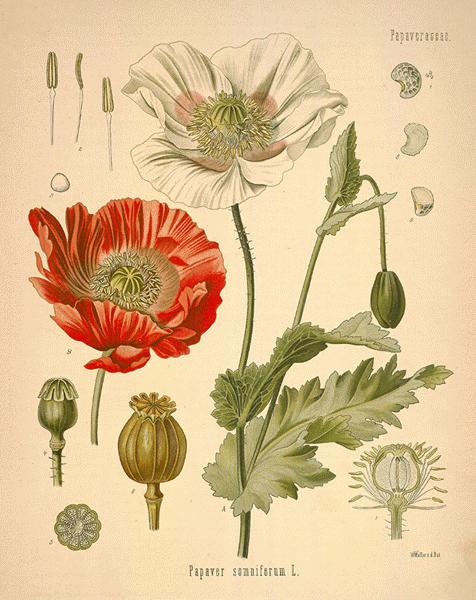 Opium is a gum harvested from the mature flower of the opium poppy or Papaver somniferum, by scraping the bulb with a specially designed knife.
 Opium has medicinal uses against pain and diarrhea, among other ailments, but it can also be ingested orally or smoked as an addictive narcotic.
Relatively simple chemical reactions can transform the active ingredient in opium gum into stronger narcotics such as morphine, codeine, or heroin. These reactions require precursor chemicals that act as reagents in the manufacture of organic compounds. The principal precursor for opium processing is acetic anhydride, which is also used in the manufacture of aspirin and photographic film.
Opium and its derivatives are controlled substances under the Single Convention on Narcotic Drugs, 1961, an international agreement administered by the International Narcotics Control Board in Vienna. This Convention was later supplemented by the 1988 United Nations Convention Against Illicit Traffic in Narcotic Drugs and Psychotropic Substances. The INCB delegates its day-to-day work of monitoring and supporting compliance to UNODC. The Convention supports controlled use of narcotics for scientific and medical purposes. Each state party to the convention is obligated to enact national legislation to outlaw:
Cultivation, production, manufacture, extraction, preparation, possession, offering, offering for sale, distribution, purchase, sale, delivery on any terms whatsoever, brokerage, dispatch, dispatch in transit, transport, importation and exportation of drugs contrary to the provisions of this Convention.Conspiracy, preparation, or financial operations in connection with these acts must also be made criminal offenses. There is no provision in the Convention for derogation from any of its provisions in times of armed conflict or emergency, as there is, for instance, in many international human rights covenants. In a recent Washington Post article, Misha Glenny argues that this prohibitionist regime and the "War on Drugs" approach to enforcing it are damaging our security. In these posts, however, I consider strategies only within the framework of this regime, to which drug policy in Afghanistan will have to conform for the foreseeable future.
Eradication
The eradication of poppy crops is by far the most photogenic tool of counter-narcotics. Press coverage and political rhetoric feature this tactic so often, that I have developed a repertoire of one-liners to encourage journalists and others question their assumptions, such as "Counter-narcotics does not equal crop eradication," or "The international drug trade is not caused by Afghan farmers."
 Eradication is the destruction of the poppy crop in the field before harvest. It can be carried out manually, by knocking over the poppy stalks; mechanically, by crushing the crop under machinery; or with herbicides sprayed from either the ground or the air. Research on eradication by genetic modification has not yet created usable technologies. Nearly all eradication in Afghanistan is done manually by Afghans, often supervised by U.S. private contractors.
 The Afghan government has rejected proposals by the U.S. to use herbicides, including aerial spraying, as has been done in Colombia, partly on the grounds that it will recall the alleged use of aerially delivered chemical weapons by the USSR in the early 1980s. Nonetheless, the U.S. Congress has for several years appropriated funds for the aerial eradication of opium poppy in Afghanistan. The U.S. Counternarcotics Strategy revives that proposal in careful language that nonetheless pressures the Afghan government to agree.
Superficial (i.e. nearly all) accounts of counter-narcotics policy assume that the purpose of counter-narcotics is to eliminate drugs, and that destroying crops that provide the raw materials for drugs is therefore essential to counter-narcotics. To foreigners it seems that Afghanistan is flooding the world with heroin, which has to be stopped. To Afghans it seems that the world is flooding a much weakened Afghanistan with demand for an illegal product, as well as weapons and political agendas over which Afghans have no control. Fairness requires that I mention that consuming countries are much better equipped to reduce demand and interdict trafficking than Afghanistan is to control supply. But the world is unfair, so back we go to counter-narcotics policy in Afghanistan.
Recall the point I made in the first installment, "Defining the Problem": counter-narcotics policy in Afghanistan should mainly be aimed at drug money, not drugs, and at the drug money that funds insurgency and corruption. In addition, it has to be integrated into the overall goals of the operation, of consolidating internationally recognized legitimate government with popular support. What effect does eradication have on those goals?
Eradication of the crop has "forward" effects on the opiate value chain and "backward" effects on the rural population. The aim of the policy is to have the forward effect of reducing drug money by reducing the amount of drugs, and the backward effect of introducing more risk into the lives of the excessively secure Afghan cultivators so that they will hesitate before planting opium poppy again. Alternative livelihoods, to be discussed in the last and final installment, are supposed to reinforce the message of eradication by providing incentives to grow other crops.
Trick question: In order to stop growing opium poppy, do Afghan farmers need to be: (a) less secure; or (b) more secure? Answer in the final installment of the series! Now back to the analysis.
Does crop eradication reduce the amount of drug revenue produced by the illicit value chain? I seem to recall from my introductory economics class 40 years ago that revenue is not just a function of the quantity produced: it is the product of price and quantity. Eradication, if successful, decreases the quantity supplied by farmers to traffickers.
 I have a dim memory of my freshman economics teacher (the late James Tobin, chairman of President Kennedy’s Council of Economic Advisers), saying that a decrease in supply leads to an increase in the price, though I don't think that is why he got the Nobel Memorial . Eradication would, if successful, decrease the amount supplied by farmers to traffickers. Since the decrease in quantity would lead to an increase in price, the effect on total revenue depends on how elastically price changes in response to changes in quantity supplied. Does the price change so slowly that revenue decreases, or does the relatively inelastic demand for an addictive substance and the high risk premium that makes the cost of production irrelevant to the prices higher in the value chain mean that incremental eradication actually raises traders’ revenues?
Both theoretical reasoning and empirical evidence indicate that any attainable amount of eradication (the current goal is 25 percent of the crop) would increase drug revenue. Perhaps some economist can provide the diagram and mathematical demonstration. On a supply and demand chart, eradication shifts the supply curve to the left; less is supplied to the market at the given price at time of planting. The post-eradication supply curve crosses the demand curve at a higher price, raising the post-harvest farm-gate price. Given the elasticities (for the reasons given above), the total revenue is likely to be greater, and therefore the benefit from corruption greater, than it would have been without eradication. Other things being equal, we would therefore expect to see an increase in drug money, a rise in the cost of bribing eradicators, and a shift of income against those who cannot afford to bribe. In other words, we would expect to see what we are actually seeing in Afghanistan today. This effect could be offset by a sufficient increase in interdiction, which lowers the amount demanded at a given price. (In terms of the diagram, interdiction moves the demand curve to the left, lowering the market clearing price.)
Evidence from both the Taliban ban on cultivation in 2000-2001 and from some localized decreases since then (especially Nangarhar in 2004-2005) is consistent with this model.
 I reproduce here the chart from the previous installment, showing the tenfold increase in opium prices due to the Taliban ban. In 2001, when traders had little new product to resell or refine, their existing stocks increased in value, and sales continued. According to Omar Zakhilwal, President of the Afghanistan Investment Support Agency (who is both a Canadian trained economist and a native of the poppy producing Momand area of Nangarhar province), opium traffickers were the main lobbyists for the ban with the Taliban leadership, as they wanted to increase the value of their inventories. Seizures of trafficked opiates across the border from
Does eradication reduce cultivation sustainably? In the year following eradication (without sufficient interdiction or alternative livelihoods), poppy cultivation is likely to rebound and migrate in response to the higher prices. According to David Mansfield, the leading researcher on Afghanistan's opium economy, farmers in the remote
 More remote areas away from the traditional areas of production also incur a lower risk of eradication. The fall of 2001 and subsequent seasons saw not just a quantitative expansion of land planted in poppy, but a diversification of location, to the point that all provinces produced at least some opium in 2005. The near elimination of poppy cultivation in Nangarhar in 2004-5 led traffickers from Eastern Afghanistan to finance cultivation in other regions of the country, which helped spread production to non-traditional areas in the north. (Left -- what I was told was the last poppy in Nangarhar, April 2005. The government is now seeking the man who told me so as a trafficking suspect.) The failure to deliver alternative livelihoods in most of Nangarhar led to the current rebound in cultivation.
Another reason that eradication does not reduce cultivation sustainably is the role of credit in the opium market. Mansfield has demonstrated convincingly through his field research that farmers, especially those with fewer assets, include poppy cultivation in their livelihood strategies in order to manage risk, largely through futures contracts. Many farmers finance cultivation (with its high labor and other costs) and food consumption during the winter by selling opium to traders before planting on futures contracts called salaam. For most of the past decade traders advanced to farmers about half of the price at harvest time of the amount contracted. For example, a farmer who made a salaam contract for 10 kg in the fall planting season of 2000, when opium was selling at about $40/kg, would have been paid $200. If he produced more than 10 kg, he could sell the rest at the harvest price or keep it as inventory. If he produced less, he would owe the balance in cash at the harvest price, which he might pay, if he could, or roll over as debt to be paid off with opium from the next growing season.
Thus in the spring of 2001, the farmer who had contracted for 10 kg that he had not be able to produce because of the Taliban ban, would still owe the 10 kg of opium, but now at the new price of about $400/kg. So the farmer would owe $4,000 to pay back a $200 loan.
 It is no surprise that these heavily indebted farmers rushed to plant opium during the U.S. invasion in 2001, especially as the money lenders were flush with $100 bills that the CIA had supplied to commanders. Traders holding dollars needed to exchange them as fast as possible, since the dollar lost over half its value against the afghani in four months due to the rapid inflow of cash (IMF data on exchange rate above).
The salaam system shifts the risk of eradication to the farmers, especially the poor, and makes it more difficult for them to adjust to eradication by planting crops with which they cannot pay off their opium debt. According to Mansfield, in response to the risk of eradication traders and money-lenders are now advancing only about 30 rather than 50 percent of the market value at planting time for salaam contracts, shifting risk to the cultivator. Even when poppy is eradicated on land belonging to a large landowner, it is likely that the landowner has rented the land to sharecroppers to whom he has advanced salaam contracts. The sharecroppers’ debts stand even if the crop is eradicated, and they stand to lose more than the landowner, who retains his claim on their assets. U.S. officials who claim that aerial spraying would enable them to be more even-handed by eradicating crops of large landowners are ignoring how Afghan rural society actually works.
Does eradication encourage peasants to reduce risk by shifting to alternative crops? U.S. officials constantly return to the theme that it is necessary to increase the risk to the greedy, secure Afghan farmers by eradicating their crop, so that they will adopt the alternatives that U.S. assistance has made available to them. I am not sure if this argument is more despicable or ridiculous; it's a tough call. (Did I forget to mention that Afghanistan is the poorest country in the world except for a handful of sub-Saharan African states, and that surveys show that 40 percent of the rural population lacks sufficient food? As they used to say in Vietnam, sorry about that.)

The outcome of the Taliban’s ban on poppy cultivation illustrates the political danger of eradication. When the
Afghan farmers in most areas will choose alternative livelihoods without eradication, when they are confident the alternatives will work. When they lack that confidence, they will choose evasion or resistance, and the more forcible the eradication, the more likely they are to turn to resistance. The risk-averse Afghan peasant and the foreign official under pressure from Congress or a parliament to show quick results have different definitions of when alternatives to poppy cultivation are available. Introducing eradication when foreigners believe alternatives are available, but when Afghans still perceive them as untried and risky, has already sparked armed resistance in some areas. Introducing eradication before farmers feel secure in the alternatives has led farmers in some areas to call upon the Taliban to protect them and take up arms to prevent eradication teams from entering their areas. Teams from the US-funded Alternative Livelihood Program, seen (rightly) as part of the same counter-narcotics package, also cannot obtain access to many communities. Road building teams are also attacked, for fear that they will improve access for crop eradication.
Since collective actions, including production, trade, politics, and war, are largely based on the mobilization of group identities (tribe, clan, family), those groups that are disadvantaged politically face a greater risk of eradication, which they counter by obtaining arms from the Taliban or other sources. This in turn enables the leaders of the groups in power to tell their Western interlocutors that their political competitors are terrorists.
More forcible eradication at this time, when both interdiction and alternative livelihoods are barely beginning, will increase the economic value of the opium economy, spread cultivation back to areas of the country that have eliminated or reduced it, and drive more communities into the arms of the Taliban.
Harjit Sajjan, a Vancouver police detective who served as an army major (reservist) in Canada's NATO contingent in the Panjwai district of Qandahar, has written me to recount his experience:
The current eradication program is pushing the farmers to the Taliban because there is no alternative livelihoods program [That is, despite the establishment of offices with signs saying, "Alternative Livelihood Program," the people do not believe that they actually have alternative ways to earn their livelihood.]. Then there is the corrupt ripple effect to the poppy eradication program where the Afghan National Police take bribes for not eradicating certain poppy fields. There were also unofficial Provincial Government poppy eradication programs that eradicate poppy fields of tribes that are part of the competition. The latter two examples pushed the local population faster towards the Taliban and helped increase the interdependency between the Drug Lords and Taliban.Sajjan concludes:
Eradication impacts the farmers who are trying to feed their families but interdiction impacts the drug lords, or what the local Afghan’s call “Dhakoos” (Bandits). The emphasis should be against the drug labs and transportation routes. This interdiction method is more efficient and has greater impact on the drug lords. Plus, it does not disrupt the farmers. This will allow the International agencies, NGOs, and military time to work on alternative programs.In the next posts, I will discuss interdiction and alternative livelihoods.

Taliban Tactical Success in Hostage Negotiations
I have been getting a lot of press calls asking me to evaluate the outcome of the South Korean hostage crisis in Afghanistan. A Radio Liberty article, "Negotiations Questioned After Taliban Releases Hostages," accurately summarizes my views (though it gets my title wrong):
Barnett Rubin, an expert on Afghanistan and director [of studies] of the Center on International Cooperation at New York University, told RFE/RL that the deal was a "tactical success" for the Taliban, but said its significance should not be overstated.But I have another question: why does the Afghan government give visas to Christian missionary organizations? There is an internationally recognized right to freedom of religious belief and expression, but there is no internationally recognized right to enter a foreign country to propagate religion. Especially in view of the social tensions that the presence of a large number of foreigners is causing in Afghanistan right now, it would be appropriate for the Afghan government to restrict entry into the country by foreign missionary organizations. Read more on this article...
"It is not a turning point in the history of Afghanistan or the history of NATO or the Western world. It just means [the Taliban] had a tactical success in gaining some political recognition by capturing some hostages -- in the course of which they also committed a war crime by executing two of those hostages," Rubin said. "They succeeded in being interviewed by the press and being treated as a negotiation partner by a sovereign government -- though not a major one. It doesn't signal anything about the political policy of anybody."
Rubin also said it is wrong to suggest that the Taliban achieved everything that it had hoped for when militants seized the South Korean aid workers from a bus in Ghazni Province."All their demands weren't met, because they were demanding the release of Taliban prisoners. But I think from the Taliban's point of view, the most important thing was that they demonstrated that they can play a role on the international stage," Rubin said. [Photo from ThanhNienNews.com: Taliban representative Qari Bashir (L) speaks to the media as Mullah Nasrullah looks on outside the Afghan Red Crescent Society in Ghazni.]
"The Taliban did behave as a coherent negotiating partner. They formulated a position. They negotiated. They reached an agreement. And they have implemented that agreement. They have succeeded in legitimizing themselves somewhat more as a political organization," Rubin continued. "But there is a tendency on the part of the media and politicians, when something gets in the headlines, to overinterpret it and [to] think that because they are paying attention to this event, it is a big turning point. It is not."
Wednesday, August 29, 2007
Post Labor Day Product Rollout: War with Iran (Cross-posted at DailyKos)!
On September 7, 2002, The New York Times White House correspondent Elizabeth Bushmiller treated readers to an explanation of how the Bush administration planned to sell the invasion of Iraq:
I watched Vice-President Cheney's speech to the Veterans of Foreign Wars on August 26, 2002, in the residence where I was staying in Kabul, Afghanistan. I heard Cheney deliver his famous falsehood:
This year, on August 28, President Bush spoke to another veterans' group, the American Legion. He called Iran "the world's leading state sponsor of terrorism," whose "active pursuit of technology that could lead to nuclear weapons threatens to put a region already known for instability and violence under the shadow of a nuclear holocaust." He concluded:
I hesitated before posting this. I don't want to spread alarmist rumors. I don't want to lessen the pressure on the Ahmadinejad government in Tehran. But there are too many signs of another irresponsible military adventure from the Cheney-Bush administration for me just to dismiss these reports. I am putting them into the public sphere in the hope of helping to mobilize opposition to a policy that would further doom the efforts in Afghanistan and Iraq and burden our country and the people of the Middle East with yet another unstoppable fountain of bloodshed. Read more on this article...
White House officials said today that the administration was following a meticulously planned strategy to persuade the public, the Congress and the allies of the need to confront the threat from Saddam Hussein.This September 11, we will have the reports from General David Petraeus and Ambassador Ryan Crocker, filtered through a White House drafted report.
The rollout of the strategy this week, they said, was planned long before President Bush's vacation in Texas last month. It was not hastily concocted, they insisted, after some prominent Republicans began to raise doubts about moving against Mr. Hussein and administration officials made contradictory statements about the need for weapons inspectors in Iraq.
The White House decided, they said, that even with the appearance of disarray it was still more advantageous to wait until after Labor Day to kick off their plan.
''From a marketing point of view,'' said Andrew H. Card Jr., the White House chief of staff who is coordinating the effort, ''you don't introduce new products in August.''
A centerpiece of the strategy, White House officials said, is to use Mr. Bush's speech on Sept. 11 to help move Americans toward support of action against Iraq, which could come early next year.
I watched Vice-President Cheney's speech to the Veterans of Foreign Wars on August 26, 2002, in the residence where I was staying in Kabul, Afghanistan. I heard Cheney deliver his famous falsehood:
The Iraqi regime has in fact been very busy enhancing its capabilities in the field of chemical and biological agents. And they continue to pursue the nuclear program they began so many years ago. These are not weapons for the purpose of defending Iraq; these are offensive weapons for the purpose of inflicting death on a massive scale, developed so that Saddam can hold the threat over the head of anyone he chooses, in his own region or beyond.We know the results.
This year, on August 28, President Bush spoke to another veterans' group, the American Legion. He called Iran "the world's leading state sponsor of terrorism," whose "active pursuit of technology that could lead to nuclear weapons threatens to put a region already known for instability and violence under the shadow of a nuclear holocaust." He concluded:
Iran's actions threaten the security of nations everywhere. And that is why the United States is rallying friends and allies around the world to isolate the regime, to impose economic sanctions. We will confront this danger before it is too late.But this apparently is just test marketing, like Cheney's 2002 speech. After all "from a marketing point of view, you don't introduce new products in August." Today I received a message from a friend who has excellent connections in Washington and whose information has often been prescient. According to this report, as in 2002, the rollout will start after Labor Day, with a big kickoff on September 11. My friend had spoken to someone in one of the leading neo-conservative institutions. He summarized what he was told this way:
They [the source's institution] have "instructions" (yes, that was the word used) from the Office of the Vice-President to roll out a campaign for war with Iran in the week after Labor Day; it will be coordinated with the American Enterprise Institute, the Wall Street Journal, the Weekly Standard, Commentary, Fox, and the usual suspects. It will be heavy sustained assault on the airwaves, designed to knock public sentiment into a position from which a war can be maintained. Evidently they don't think they'll ever get majority support for this--they want something like 35-40 percent support, which in their book is "plenty."Of course I cannot verify this report. But besides all the other pieces of information about this circulating, I heard last week from a former U.S. government contractor. According to this friend, someone in the Department of Defense called, asking for cost estimates for a model for reconstruction in Asia. The former contractor finally concluded that the model was intended for Iran. This anecdote is also inconclusive, but it is consistent with the depth of planning that went into the reconstruction effort in Iraq and Afghanistan.
I hesitated before posting this. I don't want to spread alarmist rumors. I don't want to lessen the pressure on the Ahmadinejad government in Tehran. But there are too many signs of another irresponsible military adventure from the Cheney-Bush administration for me just to dismiss these reports. I am putting them into the public sphere in the hope of helping to mobilize opposition to a policy that would further doom the efforts in Afghanistan and Iraq and burden our country and the people of the Middle East with yet another unstoppable fountain of bloodshed. Read more on this article...
Tuesday, August 28, 2007
Points on Counter-Narcotics in Afghanistan: A Critique and a Proposal (Updated)


The report and press release repeat the misconception in the U.S. Strategy that provinces with little or no poppy cultivation are "opium-free." Elites in "opium-free" provinces continue to profit handsomely from drug trafficking. The UNODC report is a welcome complement to the U.S. Strategy in that it speaks frankly though mildly of the inadequacy of alternative livelihood programs and of development for those who do not grow poppy. The report accurately links poppy cultivation (though not drug trafficking) to insecurity. Like the U.S. Strategy, it calls for the full integration of counter-insurgency and counter-narcotics measures, especially in Helmand province, which has become "the world's biggest source of illicit drugs, surpassing the output of entire countries."
In the first and second installments of this series (August 24 and 25), I took the release of the new “U.S. Counternarcotics Strategy for Afghanistan” as the occasion to analyze the US approach. On August 27, the United NationsOffice on Drugs and Crime (UNODC) released its Afghan Opium Survey 2007 at a press conference in Kabul. The press release sounded the alarm at the record production this year. The report led with two major findings:
UNODC's 2007 Annual Opium Survey showed the area under opium cultivation rose to 193,000 hectares from 165,000 in 2006. The total opium harvest will be 8,200 tonnes, up from 6,100 tonnes last year. The amount of Afghan land used for growing opium is now larger than the combined total under coca cultivation in Latin America - Colombia, Peru and Bolivia. No other country has produced narcotics on such a deadly scale since China in the 19 th century.
In the centre and north of Afghanistan, where the government has increased its authority and presence, opium cultivation is diminishing. The number of opium-free provinces more than doubled from six to thirteen, while in the province of Balkh opium cultivation collapsed from 7,200 hectares last year to zero. However, the opposite trend was seen in southern Afghanistan. Some 80 percent of opium poppies were grown in a handful of provinces along the border with Pakistan, where instability is greatest. In the volatile province of Helmand, where the Taliban insurgency is concentrated, opium cultivation rose 48 percent to 102,770 hectares.
Some colleagues asked for my ideas on how to respond to what UNODC Executive Director Antonio Maria Costa called a "grim" but "not yet hopeless" situation. I drafted a brief (though probably not brief enough) memo giving my critique of current policy and making some prescriptions. This memo is not part of the series of four installments I am posting on Counter-Narcotics in Afghanistan. The first was entitled "Defining the Problem" and the second analyzed "The Value Chain, the Corruption Chain." A third essay will discuss sanctions against narcotics production and trafficking (eradication and interdiction), and the final will discuss incentives (alternative livelihoods) and strategic sequencing. This post is a summary of the overall policy conclusions I have reached. The four longer installments will provide the analysis on which I base the conclusions below.
The Situation, the Problem, the Tools, the Goal
- •As stated in the U.S. Counternarcotics Strategy for Afghanistan, p. 13, the drug problem in Afghanistan is “drug money,” which “weakens key institutions and strengthens the Taliban.”
- According to UNODC estimates, cultivators receive only about 20% of the revenue from narcotics, and the drug money that really harms Afghanistan is the money that passes between trafficker/processors on the one side, and power holders on the other, including Taliban, Afghan government officials, and local/tribal leaders.
- These links are just as strong in northern Afghanistan as in southern Afghanistan. Drug trafficking moves north across so-called opium-free provinces as well as south. Afghanistan has an integrated drug market. Security provided by the Afghan government and international forces makes cultivation more difficult in some areas and enables farmers to earn a living through other activities, but it does not restrict drug trafficking, which flourishes equally everywhere. Helmand province (which produces nearly half the opium in the world) and its neighbors are not a drug-producing enclave unconnected to opium-free provinces. They are now the main source of raw material for the country’s largest industry, which is national in scope. Enhanced eradication of the poppy crop in Helmand without adequate other measures will raise the farm-gate price of opium and create incentives for cultivation to migrate. Suppression of cultivation in Nangarhar in the East in 2004-2005 led to the increase of cultivation in northern Afghanistan.
- Both globally and within Afghanistan, narcotics cultivation is the result of, not the cause, of insecurity. Costa emphasized the link between insecurity and narcotics production in releasing the Afghanistan Opium Assessment. The essential need for counter-narcotics policy is “a state that works” according to Colombian Deputy Minister of Defense Sergio Jaramillo. Therefore, as always, the core problem is security.
- The core tools of counter-narcotics policy are crop eradication, interdiction (which is much more complex than arresting traffickers), and development (alternative livelihoods). All are necessary in a coordinated counter-narcotics policy, but they need not be simultaneous. A list of tools is not a strategy. They have to be sequenced to achieve the right outcome. It is not true, as U.S. government spokesmen routinely state, that all counter-narcotics successes combined all three simultaneously. In Thailand the government invested in development for ten years before introducing eradication. Since the people had confidence in the alternatives by then, they accepted eradication of what little cultivation was left.
- The correct strategy for Afghanistan is to invest in development (not only rural) in all provinces, especially in the first instance in those areas that are not cultivating. Both US and UNODC spokesmen cite the figure that “only” 14 percent of the Afghan population is directly involved with poppy cultivation, but this grossly underestimates the economic dependence of the population on the drug economy, as most of the revenue comes from trafficking, processing, and protecting, not cultivation.
- Simultaneously there must be a greatly enhanced interdiction effort. Interdiction does not mean only or even primarily seizing containers of narcotics from traffickers. It is above all political and must start at the top, with the removal of high officials benefiting from the trade. This means high officials and political leaders who receive contributions or bribes from traffickers even if they have no direct contact with trafficking. This problem has to be handled politically, as it is not possible to cope with a problem of this dimension mainly through law enforcement. The key is removing people from positions or sending them out of the country, not getting legal cases strong enough to try them in the US, which, though useful as a complement to the political effort, will take far too long.
- The concept of integrating counter-narcotics and counter-insurgency by using some international military forces to assist in interdiction, including the destruction of heroin labs, is welcome and overdue. But the international forces must take extreme care during such actions not to cause civilian casualties, which have already become a serious issue in the country.
- The proposal to enhance eradication immediately, especially in Helmand, is extremely dangerous for Afghanistan. It is likely to have the following results:
- The cultivators of Helmand, who do not believe that they currently have secure access to alternative livelihoods (no matter how much money has left Washington, D.C. with that alleged purpose), will resist the eradication by mobilizing their tribes and calling for help from anti-government elements. The fact that the average cultivator in Helmand may be somewhat better off than the average cultivator in some provinces without opium cultivation is irrelevant. The security situation in Helmand has prevented effective delivery of development aid, no matter how much money has been spent.
- The Taliban will be able to consolidate their hold on districts where enhanced eradication takes place, as the government and international forces will not be able to drive them out by military means against the opposition of the population without extensive civilian casualties.
- As a result, the government and international aid will not be able to enter those areas to engage in development programs or to collect intelligence for interdiction, and counter-narcotics will be reduced to eradication, i.e. an attack on the rural population. Security will deteriorate. The Taliban will gain much more stable control of base areas that are also narcotics producing areas, similar to what the FARC has in Colombia. As in Colombia, some of these base areas may cross borders, but with far worse effects in this case.
- As security deteriorates, NATO casualties will increase, especially British and Canadian casualties in Helmand and Qandahar. The U.K. has already stated its unwillingness to sacrifice its soldiers for a U.S. policy it believes is unwise. Both the NATO commitment to Afghanistan and NATO itself as an alliance would come under severe stress.
- If the eradication effort is successful in its own terms, then the farm-gate price of opium will rise throughout the country and beyond. The market is integrated,not segmented. Since people in Balkh and elsewhere in Northern Afghanistan also do not feel secure in their alternative livelihoods, and since, as UNODC noted, the delivery of aid to these areas has been insufficient and very slow, cultivation will return to Balkh, Ghor, and other areas where it has declined. Cultivation and trafficking will also move into the tribal areas of Pakistan and Baluchistan, where the money from these activities will strengthen the Pakistani Taliban and provide resources to thwart the democratization and stabilization of the country. Opium poppy cultivation, which has already started in Diwaniya province south of Baghdad, will spread to other areas of Iraq, and trafficking and processing will start to take off.
- As the government and NATO are distracted by a strengthened Taliban in both Afghanistan and Pakistan,, they will have fewer resources for interdiction and will be less willing to take the political risk of confronting corrupt power holders in the government. Hence eradication will displace other counter-narcotics tools and the government will lose control of more territory.
- An alternative is as follows:
- Launch a public information campaign stating that the purpose of counter-narcotics is not to attack but to enhance the livelihoods of the people of Afghanistan. Afghans cannot build a stable future on the basis of a criminal enterprise that is against Islam. But they also cannot build a stable future on empty stomachs. Therefore we must work together with the 98 percent of Afghan poppy cultivators (see UNODC report) who say that they are willing to abandon poppy cultivation if they can count on earning at least half as much from legal crops. Eradication is for the other 2 percent. But first the rural population has to have confidence in the alternative.
- Ask for voluntary restraint in planting while actually delivering (not just announcing or funding or launching) much larger alternative livelihood programs. These programs must go first of all to provinces that are not planting poppy or that are reducing it. Otherwise there will be perverse incentives. Second, they should go to poppy producing provinces.
- Alternative livelihood programs must provide all the services currently provided to farmers by drug traffickers: futures contracts, guaranteed marketing, financing, and technical assistance (extension services). Micro-finance must be made easily available so that poor farmers and regions can avail themselves of new opportunities. In the last year or two such programs have finally started, but it will take several years before they start to yield returns and people have confidence in them. Fruit trees, for instance, have to mature for several years before they give a yield. People will not stop planting poppy when they have planted fruit seedlings but have as yet no fruits or market access. Alternative livelihoods are available when Afghans believe they can rely on them, not when U.S. officials assert that money intended for alternative livelihood programs has left the U.S. Treasury.
- Delivering alternative livelihood programs without forcible eradication will make it easier for the government and international forces to gain access to areas from which the population has thus far excluded them.
- Simultaneously, the government, NATO, and Coalition should undertake enhanced interdiction efforts, as envisaged in the U.S. strategy. These should start with political measures at the top, consisting of removing high officials who receive narcotics money, even if their operational involvement with narcotics is distant. Intelligence assets should be directed to obtain this information. NATO and the Coalition should provide military support to attacks on smuggling convoys and heroin laboratories, with due regard for avoiding civilian casualties. The Ministry of the Interior must be reorganized (not just reformed) from top to bottom (in that order). As currently envisaged, precursor interdiction must be enhanced.
- According to analyses by both the World Bank and UNODC, interdiction efforts will lower the farm-gate price of opium, sending the right price signals to farmers and making alternatives more viable. It will reinforce containment of cultivation.
- There will be a period of transition for both farmers and traffickers. Just as we do not arrest everyone who committed a human rights violation in the past 30 years, we need measures for reconciliation and reintegration of both cultivators and traffickers who are willing to support the government, move out of their illicit occupations, and join the development process. Alternative livelihoods are not just for cultivators. Traders and traffickers have valuable experience in marketing cash crops and providing services to farmers. Those not affiliated ideologically or organizationally to the armed opposition should be retrained to link other agro-based export industries to the countryside.
- The major traffickers have residences outside of Afghanistan and should be arrested or made extremely unwelcome in those countries where they reside. As recommended by UNODC, UN Member States should "take full advantage of Security Council resolution 1735 by adding the names of a dozen drug traffickers to the United Nations Al Qaida/Taliban list in order to seize their assets, ban their travel and facilitate their extradition."
- We need a program to manage the transition. There is no comprehensive solution through legalizing the crop or buying back all of it. There may be a possibility to use a limited and strictly controlled buy back in areas that reduce production sustainably for 2-3 years as a transitional measure. Any buy-back must be accompanied by compensatory rewards for non-poppy growing areas. Anyone benefiting from a buy-back who then engages in cultivation should be subject to eradication.
- Introducing enhanced eradication simultaneously with interdiction and alternative livelihood efforts will lead to a decrease in security and strengthen anti-government forces, while rendering interdiction and alternative livelihoods more difficult. The political purpose of counter-narcotics is to win the support of most of those involved with the drug economy by providing them with better security and links to markets than have drug traffickers, corrupt officials, and the Taliban. This does not require replacing every dollar, as the quality of licit income is much better. But it cannot mean trying to push Afghan farmers who are now used to commercial agriculture back to subsistence farming. It requires linking farmers to licit markets and agro-based industries.
- The state in Afghanistan can be built only by using the limited force available in a highly targeted and economical way against hard core opponents, while greatly expanding the incentives (where international actors should have a decisive advantage) to win people over to the side of the government and its international supporters. Done the wrong way, counter-narcotics could do to this effort what land reform did to the communists; a good idea gone bad destroyed any hope of popular support. Counter-narcotics done properly is exactly what Afghans have been asking for: removing criminal power holders and bringing security and development.
Subscribe to:
Posts (Atom)
 .
