Friday, August 31, 2007

Counter-Narcotics in Afghanistan III: The False Promise of Crop Eradication

In the first and second installments of this series (August 24 and 25), I took the release of the new “U.S. Counternarcotics Strategy for Afghanistan” as the occasion to analyze the US approach. On August 27, the United Nations Office on Drugs and Crime (UNODC) released its Afghan Opium Survey 2007 at a press conference in Kabul. On that occasion I posted a summary of my overall conclusions: Points on Counter-Narcotics in Afghanistan: A Critique and a Proposal.

In the first installment, "Defining the Problem," I argued that the U.S. Strategy defined the problem posed by drugs in Afghanistan correctly, as "drug money" that “weakens key institutions and strengthens the Taliban.” This drug money comes mainly from the 80 percent of the value of opiates in Afghanistan that, according to UNODC estimates, goes to traffickers and their protectors, not the 20 percent that goes to farmers. The second installment, "The Value Chain, the Corruption Chain," analyzed how Afghan farmers have for the first time marketed a cash crop (other than dried fruit and karakul lamb) to global markets through the creation of a value chain inside the country. Since the value chain depends on illegality, it requires a complementary chain of corruption to protect each link. The drug economy most threatens international and Afghan national goals where the value chain is linked to the corruption chain at the highest levels. Therefore breaking that link and reducing the value going into corruption and insurgency is the strategic goal of counter-narcotics in Afghanistan or any other conflict-torn narcotics-exporting country.

In this and the following post I analyze sanctions against different parts of the value chain: eradication, an intervention at the start of the value chain, which eliminates some raw material produced by cultivators, and interdiction, a term referring to all interventions higher up in the value chain such as arrests of traffickers, confiscation and destruction of drug contraband, interdiction of imports of precursor chemicals, destruction of heroin/morphine laboratories, removal from office or prosecution of officials corrupted by the trade, Security Council sanctions against travel and assets of traffickers under resolution 1735, and measures to detect, prevent, and punish money laundering.

Production and regulation of opiates
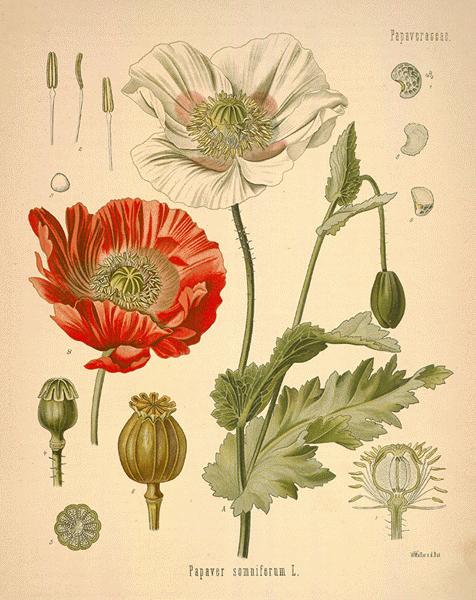
Opium is a gum harvested from the mature flower of the opium poppy or Papaver somniferum, by scraping the bulb with a specially designed knife. Opium has medicinal uses against pain and diarrhea, among other ailments, but it can also be ingested orally or smoked as an addictive narcotic.

Relatively simple chemical reactions can transform the active ingredient in opium gum into stronger narcotics such as morphine, codeine, or heroin. These reactions require precursor chemicals that act as reagents in the manufacture of organic compounds. The principal precursor for opium processing is acetic anhydride, which is also used in the manufacture of aspirin and photographic film.

Opium and its derivatives are controlled substances under the Single Convention on Narcotic Drugs, 1961, an international agreement administered by the International Narcotics Control Board in Vienna. This Convention was later supplemented by the 1988 United Nations Convention Against Illicit Traffic in Narcotic Drugs and Psychotropic Substances. The INCB delegates its day-to-day work of monitoring and supporting compliance to UNODC. The Convention supports controlled use of narcotics for scientific and medical purposes. Each state party to the convention is obligated to enact national legislation to outlaw:

Cultivation, production, manufacture, extraction, preparation, possession, offering, offering for sale, distribution, purchase, sale, delivery on any terms whatsoever, brokerage, dispatch, dispatch in transit, transport, importation and exportation of drugs contrary to the provisions of this Convention.
Conspiracy, preparation, or financial operations in connection with these acts must also be made criminal offenses. There is no provision in the Convention for derogation from any of its provisions in times of armed conflict or emergency, as there is, for instance, in many international human rights covenants. In a recent Washington Post article, Misha Glenny argues that this prohibitionist regime and the "War on Drugs" approach to enforcing it are damaging our security. In these posts, however, I consider strategies only within the framework of this regime, to which drug policy in Afghanistan will have to conform for the foreseeable future.

Eradication

The eradication of poppy crops is by far the most photogenic tool of counter-narcotics. Press coverage and political rhetoric feature this tactic so often, that I have developed a repertoire of one-liners to encourage journalists and others question their assumptions, such as "Counter-narcotics does not equal crop eradication," or "The international drug trade is not caused by Afghan farmers."

Eradication is the destruction of the poppy crop in the field before harvest. It can be carried out manually, by knocking over the poppy stalks; mechanically, by crushing the crop under machinery; or with herbicides sprayed from either the ground or the air. Research on eradication by genetic modification has not yet created usable technologies. Nearly all eradication in Afghanistan is done manually by Afghans, often supervised by U.S. private contractors. The Afghan government has rejected proposals by the U.S. to use herbicides, including aerial spraying, as has been done in Colombia, partly on the grounds that it will recall the alleged use of aerially delivered chemical weapons by the USSR in the early 1980s. Nonetheless, the U.S. Congress has for several years appropriated funds for the aerial eradication of opium poppy in Afghanistan. The U.S. Counternarcotics Strategy revives that proposal in careful language that nonetheless pressures the Afghan government to agree.
Superficial (i.e. nearly all) accounts of counter-narcotics policy assume that the purpose of counter-narcotics is to eliminate drugs, and that destroying crops that provide the raw materials for drugs is therefore essential to counter-narcotics. To foreigners it seems that Afghanistan is flooding the world with heroin, which has to be stopped. To Afghans it seems that the world is flooding a much weakened Afghanistan with demand for an illegal product, as well as weapons and political agendas over which Afghans have no control. Fairness requires that I mention that consuming countries are much better equipped to reduce demand and interdict trafficking than Afghanistan is to control supply. But the world is unfair, so back we go to counter-narcotics policy in Afghanistan.

Recall the point I made in the first installment, "Defining the Problem": counter-narcotics policy in Afghanistan should mainly be aimed at drug money, not drugs, and at the drug money that funds insurgency and corruption. In addition, it has to be integrated into the overall goals of the operation, of consolidating internationally recognized legitimate government with popular support. What effect does eradication have on those goals?

Eradication of the crop has "forward" effects on the opiate value chain and "backward" effects on the rural population. The aim of the policy is to have the forward effect of reducing drug money by reducing the amount of drugs, and the backward effect of introducing more risk into the lives of the excessively secure Afghan cultivators so that they will hesitate before planting opium poppy again. Alternative livelihoods, to be discussed in the last and final installment, are supposed to reinforce the message of eradication by providing incentives to grow other crops.

Trick question: In order to stop growing opium poppy, do Afghan farmers need to be: (a) less secure; or (b) more secure? Answer in the final installment of the series! Now back to the analysis.

Does crop eradication reduce the amount of drug revenue produced by the illicit value chain? I seem to recall from my introductory economics class 40 years ago that revenue is not just a function of the quantity produced: it is the product of price and quantity. Eradication, if successful, decreases the quantity supplied by farmers to traffickers. I have a dim memory of my freshman economics teacher (the late James Tobin, chairman of President Kennedy’s Council of Economic Advisers), saying that a decrease in supply leads to an increase in the price, though I don't think that is why he got the Nobel Memorial Prize in Economic Sciences in 1981. Eradication would, if successful, decrease the amount supplied by farmers to traffickers. Since the decrease in quantity would lead to an increase in price, the effect on total revenue depends on how elastically price changes in response to changes in quantity supplied. Does the price change so slowly that revenue decreases, or does the relatively inelastic demand for an addictive substance and the high risk premium that makes the cost of production irrelevant to the prices higher in the value chain mean that incremental eradication actually raises traders’ revenues?

Both theoretical reasoning and empirical evidence indicate that any attainable amount of eradication (the current goal is 25 percent of the crop) would increase drug revenue. Perhaps some economist can provide the diagram and mathematical demonstration. On a supply and demand chart, eradication shifts the supply curve to the left; less is supplied to the market at the given price at time of planting. The post-eradication supply curve crosses the demand curve at a higher price, raising the post-harvest farm-gate price. Given the elasticities (for the reasons given above), the total revenue is likely to be greater, and therefore the benefit from corruption greater, than it would have been without eradication. Other things being equal, we would therefore expect to see an increase in drug money, a rise in the cost of bribing eradicators, and a shift of income against those who cannot afford to bribe. In other words, we would expect to see what we are actually seeing in Afghanistan today. This effect could be offset by a sufficient increase in interdiction, which lowers the amount demanded at a given price. (In terms of the diagram, interdiction moves the demand curve to the left, lowering the market clearing price.)

Evidence from both the Taliban ban on cultivation in 2000-2001 and from some localized decreases since then (especially Nangarhar in 2004-2005) is consistent with this model. I reproduce here the chart from the previous installment, showing the tenfold increase in opium prices due to the Taliban ban. In 2001, when traders had little new product to resell or refine, their existing stocks increased in value, and sales continued. According to Omar Zakhilwal, President of the Afghanistan Investment Support Agency (who is both a Canadian trained economist and a native of the poppy producing Momand area of Nangarhar province), opium traffickers were the main lobbyists for the ban with the Taliban leadership, as they wanted to increase the value of their inventories. Seizures of trafficked opiates across the border from Afghanistan in 2001 dropped by only 40 percent compared to the previous year, implying that trafficking continued from stocks at 60 percent of the previous volume but at a price several multiples larger, so that the higher prices led to an increase in revenue to the traders. There was no sign that the cultivation ban hurt the finances of the Taliban, who, like other power holders, benefited from the opium economy mainly by taxing traders, not farmers. This example shows the effect of suppression of cultivation without interdiction of trafficking. I know of no analysis giving quantitative estimates of the effect of both eradication and interdiction on prices. Such an analysis would indicate what level of interdiction is necessary to assure that eradication does not increase the overall value of the opium economy.

Does eradication reduce cultivation sustainably? In the year following eradication (without sufficient interdiction or alternative livelihoods), poppy cultivation is likely to rebound and migrate in response to the higher prices. According to David Mansfield, the leading researcher on Afghanistan's opium economy, farmers in the remote province of Ghor for the first time found poppy farming profitable after the Taliban ban raised the price. More remote areas away from the traditional areas of production also incur a lower risk of eradication. The fall of 2001 and subsequent seasons saw not just a quantitative expansion of land planted in poppy, but a diversification of location, to the point that all provinces produced at least some opium in 2005. The near elimination of poppy cultivation in Nangarhar in 2004-5 led traffickers from Eastern Afghanistan to finance cultivation in other regions of the country, which helped spread production to non-traditional areas in the north. (Left -- what I was told was the last poppy in Nangarhar, April 2005. The government is now seeking the man who told me so as a trafficking suspect.) The failure to deliver alternative livelihoods in most of Nangarhar led to the current rebound in cultivation.
Another reason that eradication does not reduce cultivation sustainably is the role of credit in the opium market. Mansfield has demonstrated convincingly through his field research that farmers, especially those with fewer assets, include poppy cultivation in their livelihood strategies in order to manage risk, largely through futures contracts. Many farmers finance cultivation (with its high labor and other costs) and food consumption during the winter by selling opium to traders before planting on futures contracts called salaam. For most of the past decade traders advanced to farmers about half of the price at harvest time of the amount contracted. For example, a farmer who made a salaam contract for 10 kg in the fall planting season of 2000, when opium was selling at about $40/kg, would have been paid $200. If he produced more than 10 kg, he could sell the rest at the harvest price or keep it as inventory. If he produced less, he would owe the balance in cash at the harvest price, which he might pay, if he could, or roll over as debt to be paid off with opium from the next growing season.

Thus in the spring of 2001, the farmer who had contracted for 10 kg that he had not be able to produce because of the Taliban ban, would still owe the 10 kg of opium, but now at the new price of about $400/kg. So the farmer would owe $4,000 to pay back a $200 loan. It is no surprise that these heavily indebted farmers rushed to plant opium during the U.S. invasion in 2001, especially as the money lenders were flush with $100 bills that the CIA had supplied to commanders. Traders holding dollars needed to exchange them as fast as possible, since the dollar lost over half its value against the afghani in four months due to the rapid inflow of cash (IMF data on exchange rate above).


The salaam system shifts the risk of eradication to the farmers, especially the poor, and makes it more difficult for them to adjust to eradication by planting crops with which they cannot pay off their opium debt. According to Mansfield, in response to the risk of eradication traders and money-lenders are now advancing only about 30 rather than 50 percent of the market value at planting time for salaam contracts, shifting risk to the cultivator. Even when poppy is eradicated on land belonging to a large landowner, it is likely that the landowner has rented the land to sharecroppers to whom he has advanced salaam contracts. The sharecroppers’ debts stand even if the crop is eradicated, and they stand to lose more than the landowner, who retains his claim on their assets. U.S. officials who claim that aerial spraying would enable them to be more even-handed by eradicating crops of large landowners are ignoring how Afghan rural society actually works.

Does eradication encourage peasants to reduce risk by shifting to alternative crops? U.S. officials constantly return to the theme that it is necessary to increase the risk to the greedy, secure Afghan farmers by eradicating their crop, so that they will adopt the alternatives that U.S. assistance has made available to them. I am not sure if this argument is more despicable or ridiculous; it's a tough call. (Did I forget to mention that Afghanistan is the poorest country in the world except for a handful of sub-Saharan African states, and that surveys show that 40 percent of the rural population lacks sufficient food? As they used to say in Vietnam, sorry about that.)

Afghan poppy-farming communities do try to manage or reduce the risk posed to their livelihood by crop eradication. Thus far they have done so by adoption of alternative crops only in those few areas, such as the districts around Jalalabad, where the market is developed enough that they can sell other products, mainly fruits and vegetables, to traders on futures contracts. (More on how alternative livelihoods work when we come to that subject.) Since these conditions obtain in only a few areas, the main tools used to manage the risk are bribery or political influence to halt eradication or divert it elsewhere, emigration to Pakistan (the only available tactic during the Taliban ban until September 11), and armed resistance to prevent the government from establishing its authority or presence. Which tactic is more effective depends on the local situation.


The outcome of the Taliban’s ban on poppy cultivation illustrates the political danger of eradication. When the US attacked the Taliban after 9/11, throughout the Taliban’s former heartland, no one rose to defend them, and their regime collapsed rapidly. This was not due solely to the power of B-52s, big bags of C-notes, and the charisma of Hamid Karzai. The implementation of a harsh policy that attacked people’s livelihoods during a severe drought was another reason.

Afghan farmers in most areas will choose alternative livelihoods without eradication, when they are confident the alternatives will work. When they lack that confidence, they will choose evasion or resistance, and the more forcible the eradication, the more likely they are to turn to resistance. The risk-averse Afghan peasant and the foreign official under pressure from Congress or a parliament to show quick results have different definitions of when alternatives to poppy cultivation are available. Introducing eradication when foreigners believe alternatives are available, but when Afghans still perceive them as untried and risky, has already sparked armed resistance in some areas. Introducing eradication before farmers feel secure in the alternatives has led farmers in some areas to call upon the Taliban to protect them and take up arms to prevent eradication teams from entering their areas. Teams from the US-funded Alternative Livelihood Program, seen (rightly) as part of the same counter-narcotics package, also cannot obtain access to many communities. Road building teams are also attacked, for fear that they will improve access for crop eradication.

Since collective actions, including production, trade, politics, and war, are largely based on the mobilization of group identities (tribe, clan, family), those groups that are disadvantaged politically face a greater risk of eradication, which they counter by obtaining arms from the Taliban or other sources. This in turn enables the leaders of the groups in power to tell their Western interlocutors that their political competitors are terrorists.

More forcible eradication at this time, when both interdiction and alternative livelihoods are barely beginning, will increase the economic value of the opium economy, spread cultivation back to areas of the country that have eliminated or reduced it, and drive more communities into the arms of the Taliban.

Harjit Sajjan, a Vancouver police detective who served as an army major (reservist) in Canada's NATO contingent in the Panjwai district of Qandahar, has written me to recount his experience:

The current eradication program is pushing the farmers to the Taliban because there is no alternative livelihoods program [That is, despite the establishment of offices with signs saying, "Alternative Livelihood Program," the people do not believe that they actually have alternative ways to earn their livelihood.]. Then there is the corrupt ripple effect to the poppy eradication program where the Afghan National Police take bribes for not eradicating certain poppy fields. There were also unofficial Provincial Government poppy eradication programs that eradicate poppy fields of tribes that are part of the competition. The latter two examples pushed the local population faster towards the Taliban and helped increase the interdependency between the Drug Lords and Taliban.
Sajjan concludes:
Eradication impacts the farmers who are trying to feed their families but interdiction impacts the drug lords, or what the local Afghan’s call “Dhakoos” (Bandits). The emphasis should be against the drug labs and transportation routes. This interdiction method is more efficient and has greater impact on the drug lords. Plus, it does not disrupt the farmers. This will allow the International agencies, NGOs, and military time to work on alternative programs.
In the next posts, I will discuss interdiction and alternative livelihoods.

Read more on this article...

Taliban Tactical Success in Hostage Negotiations

I have been getting a lot of press calls asking me to evaluate the outcome of the South Korean hostage crisis in Afghanistan. A Radio Liberty article, "Negotiations Questioned After Taliban Releases Hostages," accurately summarizes my views (though it gets my title wrong):
Barnett Rubin, an expert on Afghanistan and director [of studies] of the Center on International Cooperation at New York University, told RFE/RL that the deal was a "tactical success" for the Taliban, but said its significance should not be overstated.

"It is not a turning point in the history of Afghanistan or the history of NATO or the Western world. It just means [the Taliban] had a tactical success in gaining some political recognition by capturing some hostages -- in the course of which they also committed a war crime by executing two of those hostages," Rubin said. "They succeeded in being interviewed by the press and being treated as a negotiation partner by a sovereign government -- though not a major one. It doesn't signal anything about the political policy of anybody."

Rubin also said it is wrong to suggest that the Taliban achieved everything that it had hoped for when militants seized the South Korean aid workers from a bus in Ghazni Province.

"All their demands weren't met, because they were demanding the release of Taliban prisoners. But I think from the Taliban's point of view, the most important thing was that they demonstrated that they can play a role on the international stage," Rubin said. [Photo from ThanhNienNews.com: Taliban representative Qari Bashir (L) speaks to the media as Mullah Nasrullah looks on outside the Afghan Red Crescent Society in Ghazni.]

"The Taliban did behave as a coherent negotiating partner. They formulated a position. They negotiated. They reached an agreement. And they have implemented that agreement. They have succeeded in legitimizing themselves somewhat more as a political organization," Rubin continued. "But there is a tendency on the part of the media and politicians, when something gets in the headlines, to overinterpret it and [to] think that because they are paying attention to this event, it is a big turning point. It is not."
But I have another question: why does the Afghan government give visas to Christian missionary organizations? There is an internationally recognized right to freedom of religious belief and expression, but there is no internationally recognized right to enter a foreign country to propagate religion. Especially in view of the social tensions that the presence of a large number of foreigners is causing in Afghanistan right now, it would be appropriate for the Afghan government to restrict entry into the country by foreign missionary organizations. Read more on this article...

Wednesday, August 29, 2007

Post Labor Day Product Rollout: War with Iran (Cross-posted at DailyKos)!

On September 7, 2002, The New York Times White House correspondent Elizabeth Bushmiller treated readers to an explanation of how the Bush administration planned to sell the invasion of Iraq:
White House officials said today that the administration was following a meticulously planned strategy to persuade the public, the Congress and the allies of the need to confront the threat from Saddam Hussein.

The rollout of the strategy this week, they said, was planned long before President Bush's vacation in Texas last month. It was not hastily concocted, they insisted, after some prominent Republicans began to raise doubts about moving against Mr. Hussein and administration officials made contradictory statements about the need for weapons inspectors in Iraq.

The White House decided, they said, that even with the appearance of disarray it was still more advantageous to wait until after Labor Day to kick off their plan.

''From a marketing point of view,'' said Andrew H. Card Jr., the White House chief of staff who is coordinating the effort, ''you don't introduce new products in August.''

A centerpiece of the strategy, White House officials said, is to use Mr. Bush's speech on Sept. 11 to help move Americans toward support of action against Iraq, which could come early next year.
This September 11, we will have the reports from General David Petraeus and Ambassador Ryan Crocker, filtered through a White House drafted report.

I watched Vice-President Cheney's speech to the Veterans of Foreign Wars on August 26, 2002, in the residence where I was staying in Kabul, Afghanistan. I heard Cheney deliver his famous falsehood:
The Iraqi regime has in fact been very busy enhancing its capabilities in the field of chemical and biological agents. And they continue to pursue the nuclear program they began so many years ago. These are not weapons for the purpose of defending Iraq; these are offensive weapons for the purpose of inflicting death on a massive scale, developed so that Saddam can hold the threat over the head of anyone he chooses, in his own region or beyond.
We know the results.

This year, on August 28, President Bush spoke to another veterans' group, the American Legion. He called Iran "the world's leading state sponsor of terrorism," whose "active pursuit of technology that could lead to nuclear weapons threatens to put a region already known for instability and violence under the shadow of a nuclear holocaust." He concluded:
Iran's actions threaten the security of nations everywhere. And that is why the United States is rallying friends and allies around the world to isolate the regime, to impose economic sanctions. We will confront this danger before it is too late.
But this apparently is just test marketing, like Cheney's 2002 speech. After all "from a marketing point of view, you don't introduce new products in August." Today I received a message from a friend who has excellent connections in Washington and whose information has often been prescient. According to this report, as in 2002, the rollout will start after Labor Day, with a big kickoff on September 11. My friend had spoken to someone in one of the leading neo-conservative institutions. He summarized what he was told this way:
They [the source's institution] have "instructions" (yes, that was the word used) from the Office of the Vice-President to roll out a campaign for war with Iran in the week after Labor Day; it will be coordinated with the American Enterprise Institute, the Wall Street Journal, the Weekly Standard, Commentary, Fox, and the usual suspects. It will be heavy sustained assault on the airwaves, designed to knock public sentiment into a position from which a war can be maintained. Evidently they don't think they'll ever get majority support for this--they want something like 35-40 percent support, which in their book is "plenty."
Of course I cannot verify this report. But besides all the other pieces of information about this circulating, I heard last week from a former U.S. government contractor. According to this friend, someone in the Department of Defense called, asking for cost estimates for a model for reconstruction in Asia. The former contractor finally concluded that the model was intended for Iran. This anecdote is also inconclusive, but it is consistent with the depth of planning that went into the reconstruction effort in Iraq and Afghanistan.

I hesitated before posting this. I don't want to spread alarmist rumors. I don't want to lessen the pressure on the Ahmadinejad government in Tehran. But there are too many signs of another irresponsible military adventure from the Cheney-Bush administration for me just to dismiss these reports. I am putting them into the public sphere in the hope of helping to mobilize opposition to a policy that would further doom the efforts in Afghanistan and Iraq and burden our country and the people of the Middle East with yet another unstoppable fountain of bloodshed. Read more on this article...

Tuesday, August 28, 2007

Points on Counter-Narcotics in Afghanistan: A Critique and a Proposal (Updated)


In the first and second installments of this series (August 24 and 25), I took the release of the new “U.S. Counternarcotics Strategy for Afghanistan” as the occasion to analyze the US approach. On August 27, the United NationsOffice on Drugs and Crime (UNODC) released its Afghan Opium Survey 2007 at a press conference in Kabul. The press release sounded the alarm at the record production this year. The report led with two major findings:

UNODC's 2007 Annual Opium Survey showed the area under opium cultivation rose to 193,000 hectares from 165,000 in 2006. The total opium harvest will be 8,200 tonnes, up from 6,100 tonnes last year. The amount of Afghan land used for growing opium is now larger than the combined total under coca cultivation in Latin America - Colombia, Peru and Bolivia. No other country has produced narcotics on such a deadly scale since China in the 19 th century.

In the centre and north of Afghanistan, where the government has increased its authority and presence, opium cultivation is diminishing. The number of opium-free provinces more than doubled from six to thirteen, while in the province of Balkh opium cultivation collapsed from 7,200 hectares last year to zero. However, the opposite trend was seen in southern Afghanistan. Some 80 percent of opium poppies were grown in a handful of provinces along the border with Pakistan, where instability is greatest. In the volatile province of Helmand, where the Taliban insurgency is concentrated, opium cultivation rose 48 percent to 102,770 hectares.
The report and press release repeat the misconception in the U.S. Strategy that provinces with little or no poppy cultivation are "opium-free." Elites in "opium-free" provinces continue to profit handsomely from drug trafficking. The UNODC report is a welcome complement to the U.S. Strategy in that it speaks frankly though mildly of the inadequacy of alternative livelihood programs and of development for those who do not grow poppy. The report accurately links poppy cultivation (though not drug trafficking) to insecurity. Like the U.S. Strategy, it calls for the full integration of counter-insurgency and counter-narcotics measures, especially in Helmand province, which has become "the world's biggest source of illicit drugs, surpassing the output of entire countries."

Some colleagues asked for my ideas on how to respond to what UNODC Executive Director Antonio Maria Costa called a "grim" but "not yet hopeless" situation. I drafted a brief (though probably not brief enough) memo giving my critique of current policy and making some prescriptions. This memo is not part of the series of four installments I am posting on Counter-Narcotics in Afghanistan. The first was entitled "Defining the Problem" and the second analyzed "The Value Chain, the Corruption Chain." A third essay will discuss sanctions against narcotics production and trafficking (eradication and interdiction), and the final will discuss incentives (alternative livelihoods) and strategic sequencing. This post is a summary of the overall policy conclusions I have reached. The four longer installments will provide the analysis on which I base the conclusions below.

The Situation, the Problem, the Tools, the Goal
  • According to UNODC estimates, cultivators receive only about 20% of the revenue from narcotics, and the drug money that really harms Afghanistan is the money that passes between trafficker/processors on the one side, and power holders on the other, including Taliban, Afghan government officials, and local/tribal leaders.
  • These links are just as strong in northern Afghanistan as in southern Afghanistan. Drug trafficking moves north across so-called opium-free provinces as well as south. Afghanistan has an integrated drug market. Security provided by the Afghan government and international forces makes cultivation more difficult in some areas and enables farmers to earn a living through other activities, but it does not restrict drug trafficking, which flourishes equally everywhere. Helmand province (which produces nearly half the opium in the world) and its neighbors are not a drug-producing enclave unconnected to opium-free provinces. They are now the main source of raw material for the country’s largest industry, which is national in scope. Enhanced eradication of the poppy crop in Helmand without adequate other measures will raise the farm-gate price of opium and create incentives for cultivation to migrate. Suppression of cultivation in Nangarhar in the East in 2004-2005 led to the increase of cultivation in northern Afghanistan.
  • Both globally and within Afghanistan, narcotics cultivation is the result of, not the cause, of insecurity. Costa emphasized the link between insecurity and narcotics production in releasing the Afghanistan Opium Assessment. The essential need for counter-narcotics policy is “a state that works” according to Colombian Deputy Minister of Defense Sergio Jaramillo. Therefore, as always, the core problem is security.
  • The core tools of counter-narcotics policy are crop eradication, interdiction (which is much more complex than arresting traffickers), and development (alternative livelihoods). All are necessary in a coordinated counter-narcotics policy, but they need not be simultaneous. A list of tools is not a strategy. They have to be sequenced to achieve the right outcome. It is not true, as U.S. government spokesmen routinely state, that all counter-narcotics successes combined all three simultaneously. In Thailand the government invested in development for ten years before introducing eradication. Since the people had confidence in the alternatives by then, they accepted eradication of what little cultivation was left.
Strategy
  • The correct strategy for Afghanistan is to invest in development (not only rural) in all provinces, especially in the first instance in those areas that are not cultivating. Both US and UNODC spokesmen cite the figure that “only” 14 percent of the Afghan population is directly involved with poppy cultivation, but this grossly underestimates the economic dependence of the population on the drug economy, as most of the revenue comes from trafficking, processing, and protecting, not cultivation.
  • Simultaneously there must be a greatly enhanced interdiction effort. Interdiction does not mean only or even primarily seizing containers of narcotics from traffickers. It is above all political and must start at the top, with the removal of high officials benefiting from the trade. This means high officials and political leaders who receive contributions or bribes from traffickers even if they have no direct contact with trafficking. This problem has to be handled politically, as it is not possible to cope with a problem of this dimension mainly through law enforcement. The key is removing people from positions or sending them out of the country, not getting legal cases strong enough to try them in the US, which, though useful as a complement to the political effort, will take far too long.
  • The concept of integrating counter-narcotics and counter-insurgency by using some international military forces to assist in interdiction, including the destruction of heroin labs, is welcome and overdue. But the international forces must take extreme care during such actions not to cause civilian casualties, which have already become a serious issue in the country.
  • The proposal to enhance eradication immediately, especially in Helmand, is extremely dangerous for Afghanistan. It is likely to have the following results:
  1. The cultivators of Helmand, who do not believe that they currently have secure access to alternative livelihoods (no matter how much money has left Washington, D.C. with that alleged purpose), will resist the eradication by mobilizing their tribes and calling for help from anti-government elements. The fact that the average cultivator in Helmand may be somewhat better off than the average cultivator in some provinces without opium cultivation is irrelevant. The security situation in Helmand has prevented effective delivery of development aid, no matter how much money has been spent.
  2. The Taliban will be able to consolidate their hold on districts where enhanced eradication takes place, as the government and international forces will not be able to drive them out by military means against the opposition of the population without extensive civilian casualties.
  3. As a result, the government and international aid will not be able to enter those areas to engage in development programs or to collect intelligence for interdiction, and counter-narcotics will be reduced to eradication, i.e. an attack on the rural population. Security will deteriorate. The Taliban will gain much more stable control of base areas that are also narcotics producing areas, similar to what the FARC has in Colombia. As in Colombia, some of these base areas may cross borders, but with far worse effects in this case.
  4. As security deteriorates, NATO casualties will increase, especially British and Canadian casualties in Helmand and Qandahar. The U.K. has already stated its unwillingness to sacrifice its soldiers for a U.S. policy it believes is unwise. Both the NATO commitment to Afghanistan and NATO itself as an alliance would come under severe stress.
  5. If the eradication effort is successful in its own terms, then the farm-gate price of opium will rise throughout the country and beyond. The market is integrated,not segmented. Since people in Balkh and elsewhere in Northern Afghanistan also do not feel secure in their alternative livelihoods, and since, as UNODC noted, the delivery of aid to these areas has been insufficient and very slow, cultivation will return to Balkh, Ghor, and other areas where it has declined. Cultivation and trafficking will also move into the tribal areas of Pakistan and Baluchistan, where the money from these activities will strengthen the Pakistani Taliban and provide resources to thwart the democratization and stabilization of the country. Opium poppy cultivation, which has already started in Diwaniya province south of Baghdad, will spread to other areas of Iraq, and trafficking and processing will start to take off.
  6. As the government and NATO are distracted by a strengthened Taliban in both Afghanistan and Pakistan,, they will have fewer resources for interdiction and will be less willing to take the political risk of confronting corrupt power holders in the government. Hence eradication will displace other counter-narcotics tools and the government will lose control of more territory.
  • An alternative is as follows:
  1. Launch a public information campaign stating that the purpose of counter-narcotics is not to attack but to enhance the livelihoods of the people of Afghanistan. Afghans cannot build a stable future on the basis of a criminal enterprise that is against Islam. But they also cannot build a stable future on empty stomachs. Therefore we must work together with the 98 percent of Afghan poppy cultivators (see UNODC report) who say that they are willing to abandon poppy cultivation if they can count on earning at least half as much from legal crops. Eradication is for the other 2 percent. But first the rural population has to have confidence in the alternative.
  2. Ask for voluntary restraint in planting while actually delivering (not just announcing or funding or launching) much larger alternative livelihood programs. These programs must go first of all to provinces that are not planting poppy or that are reducing it. Otherwise there will be perverse incentives. Second, they should go to poppy producing provinces.
  3. Alternative livelihood programs must provide all the services currently provided to farmers by drug traffickers: futures contracts, guaranteed marketing, financing, and technical assistance (extension services). Micro-finance must be made easily available so that poor farmers and regions can avail themselves of new opportunities. In the last year or two such programs have finally started, but it will take several years before they start to yield returns and people have confidence in them. Fruit trees, for instance, have to mature for several years before they give a yield. People will not stop planting poppy when they have planted fruit seedlings but have as yet no fruits or market access. Alternative livelihoods are available when Afghans believe they can rely on them, not when U.S. officials assert that money intended for alternative livelihood programs has left the U.S. Treasury.
  4. Delivering alternative livelihood programs without forcible eradication will make it easier for the government and international forces to gain access to areas from which the population has thus far excluded them.
  5. Simultaneously, the government, NATO, and Coalition should undertake enhanced interdiction efforts, as envisaged in the U.S. strategy. These should start with political measures at the top, consisting of removing high officials who receive narcotics money, even if their operational involvement with narcotics is distant. Intelligence assets should be directed to obtain this information. NATO and the Coalition should provide military support to attacks on smuggling convoys and heroin laboratories, with due regard for avoiding civilian casualties. The Ministry of the Interior must be reorganized (not just reformed) from top to bottom (in that order). As currently envisaged, precursor interdiction must be enhanced.
  6. According to analyses by both the World Bank and UNODC, interdiction efforts will lower the farm-gate price of opium, sending the right price signals to farmers and making alternatives more viable. It will reinforce containment of cultivation.
  7. There will be a period of transition for both farmers and traffickers. Just as we do not arrest everyone who committed a human rights violation in the past 30 years, we need measures for reconciliation and reintegration of both cultivators and traffickers who are willing to support the government, move out of their illicit occupations, and join the development process. Alternative livelihoods are not just for cultivators. Traders and traffickers have valuable experience in marketing cash crops and providing services to farmers. Those not affiliated ideologically or organizationally to the armed opposition should be retrained to link other agro-based export industries to the countryside.
  8. The major traffickers have residences outside of Afghanistan and should be arrested or made extremely unwelcome in those countries where they reside. As recommended by UNODC, UN Member States should "take full advantage of Security Council resolution 1735 by adding the names of a dozen drug traffickers to the United Nations Al Qaida/Taliban list in order to seize their assets, ban their travel and facilitate their extradition."
  9. We need a program to manage the transition. There is no comprehensive solution through legalizing the crop or buying back all of it. There may be a possibility to use a limited and strictly controlled buy back in areas that reduce production sustainably for 2-3 years as a transitional measure. Any buy-back must be accompanied by compensatory rewards for non-poppy growing areas. Anyone benefiting from a buy-back who then engages in cultivation should be subject to eradication.
Summary
  • Introducing enhanced eradication simultaneously with interdiction and alternative livelihood efforts will lead to a decrease in security and strengthen anti-government forces, while rendering interdiction and alternative livelihoods more difficult. The political purpose of counter-narcotics is to win the support of most of those involved with the drug economy by providing them with better security and links to markets than have drug traffickers, corrupt officials, and the Taliban. This does not require replacing every dollar, as the quality of licit income is much better. But it cannot mean trying to push Afghan farmers who are now used to commercial agriculture back to subsistence farming. It requires linking farmers to licit markets and agro-based industries.
  • The state in Afghanistan can be built only by using the limited force available in a highly targeted and economical way against hard core opponents, while greatly expanding the incentives (where international actors should have a decisive advantage) to win people over to the side of the government and its international supporters. Done the wrong way, counter-narcotics could do to this effort what land reform did to the communists; a good idea gone bad destroyed any hope of popular support. Counter-narcotics done properly is exactly what Afghans have been asking for: removing criminal power holders and bringing security and development.
Read more on this article...

Monday, August 27, 2007

Potential Designation of Sepah-e Pasdaran as a Terrorist Organization: Reactions from Tehran

I did not comment earlier about the reported designation of Sepah-e Pasdaran-e Enqelab-e Eslami (translated as the Islamic Revolution’s Guard Corps or sometimes even more carelessly as Revolutionary Guard Corps while the word sepah means army and the correct translation is the Army of the Guardians of the Islamic Revolution) mostly because over the past five years of closely monitoring the fate of Iran’s nuclear dossier, I have become skeptical of newspaper leaks, plants or commentary that hint at the possibility of eventual military action (either by the United States or Israel) against Iran right around the time or in the midst of negotiations among permanent Security Council members and Germany (P5+1) about the extension of sanctions against Iran.

This time around the story made headlines in both the New York Times and Washington Post as Iran was about to begin the third round of negotiations with the International Atomic Energy Agency (IAEA) over an “action plan” and timetable for Iran to address the remaining “unresolved questions” over its nuclear program (that agreement, the text of which was revealed today and can be found here, has already been announced as inadequate by the US even before its content was known).

The United States is also pushing for a third set of economic sanctions through the UN Security Council and as far as I can tell even the smallest hint of US military action (and the potential terrorist designation of the national army of another country is certainly a hint) has become a very useful tool not only in the process of persuading countries freaked out about yet another Middle East war that sanctions are the way to go but also in framing the Iran policy discussions domestically in the US.

Once military action becomes a possibility, then most of the energy is spent discussing why this is a terrible option while the issue at hand, which is really whether or not sanctions are good policy options, are not adequately reflected upon. In an either/or frame, sanctions or what is sometimes, I guess, euphemistically called “coercive diplomacy” in fact become the “good option” upon which a consensus can be reached. Ultimately the fundamental premise of the Bush Administration that Tehran needs to be dealt with through coercion, unless Iran agrees to US pre-conditions, and the implications of the sanctions policy for Iranian politics and Iranian people and whether sanctions will fulfill the stated objectives are rarely discussed.

The US has been sanctioning Iran in significant ways since the first term of the Clinton Administration and hopefully in a later post I will talk about how sanctions have strengthened non-transparent networks of economic middlemen in Iran whose lucrative activities during the Saddam era sanctions against Iraq (yes Iraq) as well as close ties to various state institutions have enriched them enough to influence Iranian politics in significant ways, particularly since Iran’s borders with neighboring countries (now all American allies) are so porous.

But here I want to talk specifically about the impact of the recent news about the placing of Sepah on the terrorist list on Iranian politics. In the words of David Ignatius of Washington Post, through this designation, which he suggests is part of a new post-Iraq strategy, the Bush administration hopes to “squeeze the guard and all of the businesses it owns -- banks, trading companies, tech companies that are part of the nuclear program -- and seek to divide President Mahmoud Ahmadinejad, himself a product of the guard, from Iran's less fanatical majority."

A close look at the reaction from Tehran, however, clearly encapsulates how such moves push the whole array of political forces to the right of the political spectrum and in fact strengthen precisely the same forces that the publicized policy presumably intends to weaken. This, I think, is the story of American foreign policy vis-à-vis Tehran; a story that very few people in the Bush Administration or the US Congress (which since 1990s has done everything possible to outdo the executive branch in this sanctions game) are willing to confront.

Now let’s see what happened in Tehran once the news hit the headlines. The government did not respond officially. In fact, only a Foreign Ministry official who wished to remain anonymous (yes the Iran has them too!), characterized the publicity as part and parcel of the “psychological war” in which the US has engaged in the past couple of years in order to intimidate Iran.

The conservative organizations and newspapers did respond but they did so with either a yawn or their usual bombast and ridicule about American failures in Iraq and how these failures leave the US no other options but to find scapegoats. In an August 23rd editorial entitled “Paper Presence,” this is how Kayhan, Tehran’s most important hard-line daily reacted to the news:

If the news is correct, it is another sign that the Americans neither have sufficient intelligence for the correct understanding of their problems in the Middle East nor do they have much wisdom for addressing them. The excuse, they say, is that Sepah is helping Hezbollah, Hamas and [Islamic] Jihad and other similar groups…. The US imagines that these groups have modeled their fighting after Sepah and further claims that Sepah trains or arms them; claims that are repeated for years without an ounce of evidence ever presented to support them…. It is understandable that it is difficult for Israel and the United States – and the shame associate with it even harder – to accept and for the world to believe that with all their claims and pride they have been humiliated in front a few hundred Kalashnikov carrying youth. This is why in their own minds they have found a solution … by enlarging their adversary they want to belittle their own defeat or at least find an excuse for it. But let us say that the Jihadi groups in the Middle East region were created by Sepah and are now under its protection – which they are not and America knows this truth better than anyone else, is the solution to take a torn piece of paper and write on it that Sepah is terrorist? Will this solve the American problem?... The Americans imagine that the solution to the strategic defeat that has beleaguered them in the Middle East is paper play and issuing of declarations and resolutions. Sepah, if we accept America’s ridiculous claims, has taken America to the point of desperation on the boiling sands of Iraq, expansive plains of Lebanon, and swarming cities of Palestine. If there is a response to Sepah, then it must be given there. Apparently, however, there is no response and members of Sepah, by traversing time and place, are in a position that the US must await a new wonder from them at any given moment…

But ridiculing the significance of the US decision, if it happens, does not prevent hard-line or conservative forces from using the proposed terrorist designation in their attacks against domestic opponents. Suggesting that the idea of placing Sepah on the terrorist list can be associated with a few members of the Iranian exile community in the United States with past links to the reformists, Baztab, a website associated with Mohsen Rezaie, the former commander of Sepah, in an August 21st piece subtitled “A Test for the Patriotism of the Reformists” demands:

Now that the hard-line American circles are pretending that in confronting Sepah-e Pasdaran they have the reformists on their side, time has arrived for well-known leaders of that array of groups to defeat this plan through a clear statement of their position… Time has arrived for organizations such as Association of Combatant Clerics, The National Confidence Party, Servants of Construction, Mojahedin of Islamic Revolution and Participation Front and figures such as Khatami, Karrubi, Mir Hossein Mussavi, Mohtashamipour, Karbashchi and others, who despite critical positions regarding certain issues have also shown their support for their territorial integrity of the country to enter the fray and prevent any kind of western pretensions on behalf of the reformists.

And the call has not gone unheeded. Almost every reformist organization has since come out with a written statement in support of Sepah, echoing what Mohammad Khatami, Iran’s former reformist president, said in an interview with ISNA (Iranian Students News Agency) against the potential move:

If the hard-line war mongers in the United States do not know, I am sure the wise and just of that country know that Sepah has risen from the main beliefs and longings of a nation, is one of the main pillars of national authority and security, is the protector of the nation’s rights, values of the revolution, and territorial integrity, and form the spiritual point of view has a special place among the people of Iran. No nation can accept being subjected to aggression or even insult against the backbone of its authority and security and guardian of its territorial integrity, honor, and independence.

Khatami goes to hope that “illogical extremists” will be prevented from steering American foreign policy and calls on the “wise” in both countries to prevent another crisis, while posing a question about which people will benefit from the leakage of such a news in the midst of US-Iran discussions of and Iran’s attempts to respond to the unresolved technical questions regarding its nuclear program.

To be sure, Khatami’s interview along with written statements issued by political groups such as the National Confidence Party, Mojahedin of Islamic Revolution and Participation Front all include an implicit and at times even explicit criticism of hard-line posturing against the United States and lack of prudence on the part of the Iranian government in its dealings with the United States. But make no mistake, the mere reporting on the possibility of terrorism designation of Sepah has had a rallying effect on the significant players of the Islamic republic and once again has made it easier for had-line forces in Iran to make the case that conciliatory moves towards the United States (either in relation to Iraq or more significantly in relation to Iran’s nuclear file) are of no use since US policy objectives in Iran are not behavior change but regime change. Read more on this article...

Saturday, August 25, 2007

Counter-Narcotics in Afghanistan II: The Value Chain, The Corruption Chain

In the first installment of this series, I took the release of the new “U.S. Counternarcotics Strategy for Afghanistan” as the occasion to analyze some flaws in the US approach.

As I noted there, in these posts I will confine myself to considering strategies within the framework of the current international prohibitionist regime for narcotics, including opium and its derivatives. In a recent Washington Post article, Misha Glenny shows how the "War on Drugs" is damaging our security. The next few years of drug policy in Afghanistan, however, will conform to that regime, which I take as a given here.

In the first installment, "Defining the Problem," I argued that the U.S. Strategy defined the problem posed by drugs in Afghanistan correctly, as "drug money" that “weakens key institutions and strengthens the Taliban.” Furthermore, the drug money that harms our goals in Afghanistan comes from the 80 percent of the value of opiates in Afghanistan that, according to UNODC estimates, goes to traffickers and protectors (left -- opium bazaar in Qandahar), not the 20 percent or less that goes to farmers, whose support the government needs. A counter-narcotics strategy that serves our security goals would win over the farmers and many others involved in the industry, while we and the Afghan government help them adjust to the shock of being subject to international rules, while isolating the few who wish to use illicit revenue to fund insurgency and terrorism. Instead, the administration has adopted the Afghan equivalent of "shock treatment" in the former USSR: a "War on Drugs" approach, as if it is trying to end drug addiction in the West by attacking Afghan farmers.

The comparison to post-Communist shock treatment may seem strange. But what has happened to Afghanistan is not just drugs and terrorism: for the first time in history, the Afghan peasantry has started producing a cash crop for the international market. The peasantries of other countries faced this challenge under colonialism, when they produced (or lost their land to plantations that produced) rubber, tea, coffee, indigo, sugar, cotton, tobacco, and many other products. Caffeine, nicotine, and alcohol (in the form of rum) all came to the consumers of the developed world through the same kind of transformation that is now bringing them cannabis, opiates, and cocaine, except that the latter are now considered to be illegal. Just as sudden integration with the international finance and product markets required a shocking readjustment in the former Communist countries, the move from an illicit form of export mono-culture to a licit economy requires an immense upheaval in Afghanistan. Both transitions can destroy the economic security of millions and provoke the type of backlash we now see in Russia, but with even more dangerous consequences in Afghanistan, given the presence of al-Qaida. Avoiding this backlash should dictate the pace that crop eradication plays in counter-narcotics strategy.

In no case have countries undergone a transition from an economy based on cash crop exports back to subsistence farming. Alternative livelihood programs have to follow in the footsteps of the drug traffickers, linking Afghan farmers to the market, but with licit crops that, alas, cannot profit from Afghanistan's comparative advantage in producing illegality, but that might be able to profits from international interest through a "Made in Afghanistan" brand. This is what Gulestan is trying to do. Given the significant capacity for production, marketing, and finance that the opiate economy has developed in Afghanistan, we need to transform rather than destroy much of this capacity, a goal that should inform our approach to the 80 percent of the value of opiates produced by processing and trading.

Designing a strategy that focuses on the part of the opiate economy that destabilizes the region and undermines the rule of law requires an analysis of the value chain in the opiate industry through which the raw material is produced, refined (below) , and marketed, adding illicit value at each step. This analysis both suggests how to intervene (through eradication and interdiction) in a way that does the most to stop the flow of illicit drug money; it also suggests how alternative livelihood programs can create value chains for licit products.

I am told that the classified version of the U.S. Strategy includes a discussion of money laundering and high-level corruption. No doubt some of the information, especially about specific individuals, is very sensitive. But there is nothing secret or sensitive about the general process of heroin refining,financing, trafficking, and protection. We have already seen the result of focusing efforts at the bottom of the value chain: when the Taliban suppressed cultivation while permitting trafficking in 2000-2001, the returns shifted upward in the value chain, as farmers lost their crop while traffickers profited from a ten-fold price increase, while lowered the unit cost of smuggling. Except for an increase in expected bribes, the cost of smuggling a kilogram of opium that costs $600 is the same as the cost of smuggling a kilogram of opium that costs $60.

Defenders of the policy make the seemingly obvious (but completely wrong) point that eradication of poppy decreases the quantity of drugs and therefore the money from drugs. They seem unaware of something that intervenes as drugs are converted into money: PRICES. And when an intervention (crop eradication, bad weather) lowers the quantity supplied, prices go up (see chart above to see the price effect of the Taliban ban).

The value chain includes many different prices: raw opium at the farm gate; raw opium at the bazaar; processed morphine or heroin leaving the laboratory (which requires the import of precursor chemicals not made in Afghanistan; heroin and raw opium at the border and across the border, as they are transferred to international traffickers. Prices increases geometrically as one ascends the value chain, accounting in part for the increasing share of opiate profits going to traffickers (see below, based on UNODC data).

At each stage of the value chain, different power-holders take shares of the profit to provide various services, including the service of not killing you (the well-known "make him an offer he can't refuse," which in Afghanistan, I am told, can take the form of "take this $1,000 or I'll kill you in a particularly painful way.") In villages the farmers contribute a share to the mosque (sometimes conceptualized as the Islamic tax, ushr), which is used to pay the mullah and for local public expenditures such as teachers' salaries, medical care, or irrigation. The small traders who come to the village have to pay the police (or Taliban) whom they pass on the road, who pass a share up to their superiors. The police chief of the district may have paid a large bribe to the Ministry of the Interior in Kabul to be appointed to a poppy producing district; he may have also paid a member of parliament or an influential person to introduce him to the right official in Kabul. These officials may also have paid bribes (or, at this level, "political contributions" that are no longer recognizable as deriving from narcotics) to obtain a position where they can make so much money.

Running a heroin laboratory requires payments to whoever controls the territory -- in most cases a local strongman plus the government or the Taliban. Importing precursors requires bribing border guards (perhaps on both sides of the border) or paying an armed group for a covert escort. Smuggling the opium, morphine, or heroin out of Afghanistan requires access to an airfield (heroin seized at Kabul International Airport, right) or border crossing (controlled by the border police and Ariana Airlines, both of whose employees are reported to make significant income from drug trafficking), the escort of armed groups (Taliban, tribes, commanders), or expensive specialists in packaging such as those who seal heroin inside empty almond shells or condoms. The bureaucratic, military, political, or social superiors of those directly involved in facilitating trafficking claim a right to shares of the resulting tribute, though the higher the money moves, the less evident is its connection to the flowers that the foreigners like to photograph.

Different counter-narcotics tools intervene at different points of the value chain and thus affect prices, quantity, and the distribution of profits differently. The strategy that lowers the physical supply of drugs the most is not the strategy that most effectively stops drug money from funding corruption and insurgency. Nor is it the strategy that improves security or creates stabilizing political alliances. In the next installment, I will discuss eradication and interdiction in the light of this analysis.


Read more on this article...

Friday, August 24, 2007

Counter-Narcotics in Afghanistan (First Installment): Defining the Problem

The U.S. Department of State Bureau of International Narcotics and Law Enforcement released a new “U.S. Counternarcotics Strategy for Afghanistan” this month. The strategy calls for added efforts in all pillars of the Counter-Narcotics effort in Afghanistan, but its most salient change from the past is its proposal for more forceful and extensive eradication of opium poppy crops. The Strategy calls for “non-negotiated” eradication, ostensibly in order to avoid the manipulation of eradication by local elites to exempt their own crops and focus eradication on their rivals or the powerless. While the Strategy states that no means of eradication will be used without the approval of the Government of Afghanistan, it contains many examples of thinly veiled pressure on the Government of Afghanistan to authorize the spraying of herbicides both from the ground and from the air.

Implementation of this strategy will lead to a rapid deterioration of security at least in the south of the country and the further weakening of the Afghan government. Afghans will conclude (if they have not so concluded already) that the U.S. does not consider Afghanistan to be sovereign and that the foreigners are in Afghanistan to pursue their own agenda, not to help Afghanistan. Significant portions of the countryside that have been neutral or pro-government will move toward the Taliban. The farmers will respond to the greater risk imposed by eradication not by stopping poppy cultivation but by preventing the government and international community from entering their areas. By and large, they will succeed, especially as US resources, credibility, and alliances continue to be drained by the disastrous war in Iraq.

Currently, the Taliban-led insurgency does not have stable and exclusive control of any significant territory and population in Afghanistan, as does the FARC in Colombia. Areas subject to aerial spraying for crop eradication, however, are likely to come under much more stable Taliban control. The government and its international supporters will be unable to enter such areas to provide development assistance or to engage in interdiction. Hence the more that aggressive eradication and aerial spraying are introduced before Afghans believe they have secure alternative livelihoods, the more the counter-narcotics policy will be reduced to eradication by military means, amounting to a war on the livelihood of the part of the Afghan rural population most vulnerable to Taliban influence.

Implementation of this strategy will also undermine attempts to stabilize the tribal areas of Pakistan and Baluchistan, by providing incentives for drug traffickers to move their operations into those areas just as Pakistan is undergoing a political crisis with unpredictable results.

The continuing escalation of tension between the U.S. and Iran will also promote the success of drug trafficking, as does the lack of U.S.-Iranian cooperation on counter-narcotics, the policy area where they have the clearest common interest. If the administration attacks Iran, as many observers are predicting, Iran will respond in such a way as to make much of Afghanistan ungovernable, including regions that the US government seems to think are under the stable control of the government. Counter-narcotics and many other policies will become impossible to implement. Iran's current activities in Afghanistan are both preparing for such an eventuality and signaling what it can do. As I will discuss in subsequent posts, the administration can have a confrontation with Iran or some success in Afghanistan, but not both.

I have read only the unclassified version of the Strategy. I am told that the classified version includes some of the elements that are missing in the open version, in particular on money laundering and high-level corruption. Those with the needed access can decide whether those sections meet some of the objections in my critique.

In a short series of posts, I will suggest why I find the proposed strategy so dangerous to international strategic goals in Afghanistan. In these posts I will confine myself to considering strategies within the framework of the current prohibitionist international regime for narcotics, including opium and its derivatives. I have argued elsewhere (including in front of the Senate Foreign Relations Committee), that
The international drug control regime, which criminalizes narcotics, does not reduce drug use, but it does produce huge profits for criminals and the armed groups and corrupt officials who protect them. Our drug policy grants huge subsidies to our enemies.
Over the next few years, at least, we will be working within that regime, which I take as a given here.

This first post deals with defining the problem and understanding the situation.

Overall goals:

The overriding goal of the U.S. and allies in Afghanistan is stabilizing the government and the region to (1) assure that al-Qaida cannot re-establish its bases in Afghanistan and (2) destroy al-Qaida’s current sanctuary in some of Pakistan’s tribal agencies. There are (and were long before 9/11) moral, humanitarian, and altruistic reasons to try to heal the wounds of Afghanistan and provide its people with a better life, but those reasons did not inspire the intervention that has been taking place since October 2001. The strategic goal is related to the ethical ones, however: the only long-term way to secure the region is to strengthen the state institutions and economies of both Afghanistan and Pakistan to the point that they can enforce norms of the international system with the consent of the people throughout their territories.

Among the many reasons that the US, UN, NATO, and dozens of donors and troop contributors are NOT in Afghanistan is to stop drug addiction in Europe or the U.S. Mounting a major state building effort in Afghanistan would hardly be the appropriate means to attain that goal. This does not mean that Donald Rumsfeld’s original policy of turning a blind eye to drug trafficking by counter-terrorism allies was right. That view of counter-narcotics was based on the same myopic vision that saw counter-terrorism solely as a "kill and capture" mission, whereas it can succeed only if it establishes the basis for effective security and policing. Policing and law enforcement, unlike military action, require the consent of the bulk of the population. That is why efforts to eliminate narcotics in a badly governed or ungoverned state tend to drift into a military mode (war on drugs). I will explain that when I discuss interdiction.

So what is the problem posed by the narcotics economy? The narcotics sector consists of economic activities whose profit (or rent) derives from illegality. The final price of narcotics is determined mainly by the cost of smuggling and distributing an illegal product rather than by conventional costs of production. Afghanistan’s principal comparative advantage is not in poppy cultivation but in the production of illegality. It is cheaper to engage in illegal activity in Afghanistan than almost anywhere else in the world. Iraq is catching up, however. Having first followed Afghanistan's lead in becoming a major haven for transnational terrorism, Iraq is now starting to produce opium poppies.

Thus Afghanistan's drug economy expanded when the state broke down after 1992. It consolidated itself and expanded further under the Taliban, because the Islamic Emirate was a peculiar type of state: internally it strictly enforced its own laws and brought security to trade routes and rural areas, at least in the Pashtun zones. But the government was not recognized internationally and did not recognize international law. Narcotics was profitable because it was illegal beyond the borders of Afghanistan, but it could expand securely within Afghanistan because of the security and administrative control of their regime. It consequently produced only modest revenues inside Afghanistan, compared to today.

Since the Taliban never treated drug trafficking as a crime, and forbade poppy cultivation for only one year, the drug trade provided little or no opportunities for corruption within Afghanistan. This changed only during the year that the Taliban banned poppy cultivation (2000-2001), though they never banned trafficking. The Taliban ban, by criminalizing part of the opium economy, made the narcotics economy far more profitable –prices rose ten-fold. Though prices have declined since then, they have never returned to the competitive levels of the period when the entire drug economy was de facto legal inside Afghanistan.

The current government, however, is committed to (in the words of the preamble to the Constitution of 2004/1382) “restoring Afghanistan to its rightful place in the international community.” Hence, unlike the Taliban Emirate, the government cannot tax, regulate, or settle disputes arising from the main economic activity in the country. Instead the constitution provides:
The state shall prevent all types of terrorist activities, the production and consumption of intoxicants (musakkirat), and the production and smuggling of narcotics.

While I cannot prove it with survey data, my informal observations lead me to conclude that the social consensus in Afghanistan is that poppy cultivation and drug trafficking are wrong, but that they are inevitable and excusable (at least cultivation and small trading are) until economic alternatives develop. (I will discuss the view of the ulama in a subsequent post on interdiction and law enforcement.)

Narco-economy: the tax base for insecurity

The participants in the narcotics economy must govern this economic sector (about a third of the economy, at least half of the cash economy) through activities that are “illegal,” but that are hidden mainly from foreigners rather than other Afghans. The Afghan police and administration, political leaders, and the anti-government insurgents all offer protection services to poppy growers and drug traffickers. Competition for this lucrative role motivates much of the violence in the country. The U.S. Strategy probably overstates the relative importance of the Taliban and al-Qaida in protecting the trade and understates the degree to which the narco-economy is controlled by officials and political leaders in the Afghan government. Portraying the drug economy as primarily supporting terrorism, however, does make militaristic approaches to it seem more acceptable.

Hence the narcotics economy corrupts and weakens the government, undermines stable economic development, and funds terrorism and insurgency. It also promotes dishonesty between Afghans and foreign officials, since the former cannot tell the latter what they really think. Political insurgents, whether national or transnational, predatory officials, and illegal businessmen have a common interest in preventing consolidation of the government or rule of law. The rents from illegality provide them with the resources to undermine security, though, like the Taliban, they also use these resources to provide the local security that the drug economy needs. From the point of view of Afghan poppy cultivators, eradicators provide insecurity, and leaders (whether in the government or Taliban) who can keep eradicators out provide security. Hence poorly designed and implemented counter-narcotics policies drive many disparate forces together, though most are not ideologically committed to transnational terrorism.

On pages 13-14, the US Strategy (“Defining the Problem”) correctly diagnoses the problem as “drug money,” which “weakens key institutions and strengthens the Taliban.” But this diagnosis has consequences that the Strategy does not draw. A strategy to lessen the flow of drug money into corruption and insurgency is not identical to a strategy to reduce the quantity of addictive substances produced and exported. Once the US Strategy accurately diagnoses the problem as “drug money,” it then reverts to a nearly exclusive focus on drugs themselves, and not even on heroin, which produces much more drug money, but on poppy cultivation, which accounts for at most 20 percent of the drug economy in Afghanistan but has become the photogenic Paris Hilton of Afghan narcotics policy. This analytical flaw is the root cause of most of what I believe is wrong with this strategy.

The focus on flowers rather than drug money has led to a false comparison between northern and southern Afghanistan. U.S. officials now imply that political elites in northern Afghanistan are engaging in successful counter-narcotics, while the southern drug economy expands. This depiction has obvious ethnic implications, to the point that one government (not the U.S.) asked me to comment on whether different ethnic groups have different cultural attitudes toward opium.
The basis for these generalizations is that poppy cultivation spread into Afghanistan mainly through the Pashtun areas and that in the last year poppy cultivation has decreased in the mainly northern provinces (see the UNODC Rapid Assessment Survey map). The main reason that the drug economy expanded the most in the Pashtun areas is that traffickers shifted the cultivation to Afghanistan from Pakistan when Islamabad started to suppress it in the 1980s, and the government collapsed in Afghanistan. As a trans-border people, Pashtuns are well-organized for smuggling, whether of opium, weapons, or spare parts for trucks.

But most importantly, the map shows only the flowers. The U.S. Strategy nowhere claims, discusses, or even mentions whether “drug money” has decreased in northern Afghanistan. It has not. Balkh may be poppy-free, but its center, Mazar-i Sharif, is awash in drug money. The commanders who control Northern Afghanistan today are playing the same shell game that the Taliban did in 2000-2001. Some have suppressed cultivation (in Ghor and Bamiyan cultivation is hardly worthwhile anyway, the yields are so poor) but none have moved against trafficking. Most of them continue to profit from it, if only through what in the U.S. we would call "political contributions."

Some of the same officials who today get credit for counter-narcotics efforts are generally believed to have become millionaires directly or indirectly from drug trafficking. Recently the nephew and right-hand man of the chief of the border police in a province colored a hopeful green in the map above was caught driving a car full of heroin north through Kabul. Why? Because there is still plenty of trafficking going through the North, and trafficking, not cultivation, is where the money is. An Afghan friend (and official of the Afghan government) told me that when he was in Bamyan recently, the north-south road by the lake at Band-i Amir was crowded like a highway with trucks taking the opium and heroin of Helmand northwards. (This is the same road that the mujahidin used to transport arms from Pakistan to northern Afghanistan in the 1980s.) The same traffic goes through Ghor, to the west. The arms traffic goes in the other direction, as northern commanders sell their Iranian weapons to dealers who re-sell them to the Taliban.

The commanders have learned that we pay no attention to the money but only to bright colored flowers. And what both government officials and politically connected people tell me is, the pressure for photogenic progress comes from Congress. Every year it wants easily depicted metrics, and flowers provide it. Perhaps someone from the legislative branch would like to comment on this.

In the next installment, we will look beyond the flowers to analyze the implications of the neglected opiate value chain for counter-narcotics policy. Read more on this article...

Thursday, August 23, 2007

Winds of Change

The Supreme Court decisions continue to change the landscape of Pakistan's history and politics. Since Chief Justice Chaudhry Iftikhar's reinstatement on July 20th, 2007 [see Justice's Turn], the Supreme Court has released various political prisoners, most notably Javed Hashmi.

Today, the Supreme Court has ruled that Nawaz Sharif, the deposed Prime Minister, can return from exile to Pakistan.

Nawaz Sharif, you may recall, was the Prime Minister whose administration fell to Pervez Musharraf's military coup in 1999. Since then, he has been living in Saudi Arabia and London - forced, he says, to agree to a 10 year long exile by Musharraf's regime. A similar exile was arranged with Benazir Bhutto. The reason these leaders agreed to the exile may have to do with the myriad anti-corruption cases launched against their persons and administration by Musharraf's government [some are highly merited - and are currently active in the courts].

Benazir Bhutto has recently met with Musharraf and been in discussions to return to Pakistan as well. She gave some details of those "power-sharing" arrangements but this decision by the Supreme Court will undoubtedly complicate, if not make moot, such discussions.

Both exiled ex-PMs Benazir Bhutto and Nawaz Sharif want to be back in Pakistan by October and running for re-re-re-election in December. Hopefully.

What does it all mean? In terms of internal politics of Pakistan, this is tremendous news for the resurgent democratic movement in Pakistan. The full participation of the many political parties - including the Bhuttos and Sharifs - will guarantee that Pakistan start recovering from the despotic military regime. However, that is easier said than done. The military, under Musharraf, has become the largest land-owning, asset-controlling entity in Pakistan with ex- and current military officials serving across the civil and social landscape. How can that military be coaxed "back into the barracks"? It is quite probable that there are forces within the military eager to curtail their political vulnerabilities. The popular image of the military in Pakistani society has underwent tremendous change in recent years - from a highly valued and respected institution (the only "corruption-free" one) to a hegemonic and undesirable presence. I could argue that the military's own interests lie in withdrawing from the political realm and re-burnishing its image and standing. Of course, the defense budget remains the highest expenditure in the country and no successive civil government will change that. By and large, the military cannot lose by "giving democracy back" to the country. That was, after all, what Musharraf claimed when he took control.

In terms of oft-mentioned "Talibanization" of Pakistan and the wider conflict with extremism, the answers are less apparent at the moment. Some certainties do exist: any civil government will continue to fully cooperate with the US efforts. In fact, the efforts in Waziristan would be strengthened by the participation of Baluchistani leaders at the Federal level [Baluchistan has always been a Federal/State controversy]. The elections will not result in any rise-to-power of Mullah Omar in Islamabad. And a democratic Pakistan will surely be a far valuable ally within the Muslim world. The uncertainties largely hinge on the nature of the elections - the participation of various groups and their freedoms to do so. It will also be a chaotic period which can make Pakistan vulnerable to further attacks and incursions.

However, the bottom line is that Pakistan needs full and immediate US support through the next six months. UN should take an interest in insuring fair elections. And the subsequent government should be cultivated and nourished throughout the full term. Read more on this article...

Wednesday, August 22, 2007

Taiwan: Economic Development in Central Asia

The USG Open Source Center summarizes Taiwanese reports on the economies and politics of Central Asia in the context of projects of the US Agency for International Development and Chinese, Russian and American geopolitical competition in the region.

Highlights: Development in Central Asia
Taiwan - OSC Summary
Tuesday, August 21, 2007

Special Report on Developments in Central Asia

According to a Chung-kuo Shih-pao report of 6 August 2007 by Chang Hui-ying entitled " Taiwan's Foreign Aid Comparatively Too Politically-Oriented," the US Agency for International Development (USAID) has a wide range of aid programs, including coaching high school students to start businesses; improving the quality of justice by introducing the recording of trials; training media to conduct investigative reporting; and assisting in policy design. In 1992, USAID provided nearly NT$1.5 billion in aid to Central Asia. In 2000, it helped some women in Tajikistan file a lawsuit over a land dispute, and the women got their land back this year. If there was any ideology involved, it was a belief in the value of democracy, liberty, and equal human rights. This is not only so for the governmental aid-provider but also for the non-government organizations (NGOs). They refused to serve special political interests and be used as a political tool, which might just be what Taiwan's foreign aid program needs.

According to a Chung-kuo Shih-pao report of 6 August 2007 by Chang Hui-ying entitled " US-Russia-China Wrestle for Energy," Central Asia, since its independence, has been the battleground for the United States, Russia, and China for several runs. The first took place from 1991 to 2001 when the US got involved in Central Asia after the dissolution of the USSR and provided economic aid to secure gas and oil sources, to expand NATO and to propagate the ideas of democracy and human rights. The second took place from the terrorist attack on 11 September 2001 to 2005 when anti-terrorism was the top priority for the United States which built eight military bases in the region. The third took place from 2005 until now when revolution shocked the Central Asian leaders who asked the US bases and inter-governmental organizations (IGOs) to get out of Central Asia. China and Russia have collaborated in the containment of the United States by means of Shanghai Cooperation Organization. The three big states are all after energy. In the competition, the United States and the European Union apparently were defeated by Russia, which has reached agreements with Turkmenistan and Kazakhstan on the renovation and construction of oil pipelines. Culturally and sentimentally, Central Asia felt closer to Russia, which has also been the main trading partner with Central Asia. People in Central Asia do not like the United States and were unhappy about China because of the influx of cheap goods made in China and illegal Chinese workers. Central Asia has retained a degree of autonomy and balance in terms of foreign policy. At the end of the day, national interests remained the most important.

According to a Chung-kuo Shih-pao report of 8 August 2007 by Chang Hui-ying and Chen Yi-shan entitled "' Switzerland of East' Has Democracy But Is Poor," Kyrgyzstan, often called the "Switzerland of the East," has been the most democratized of the five countries in Central Asia, which unfortunately has not brought about economic prosperity. Its economy has been seriously affected by the "Tulip Revolution" in 2005. Although Kyrgyzstan opened up to US military bases and was the first in Central Asia to join the WTO, former president Akayev had to resort to the old route of totalitarian rule for more effective government. Weak government and unstable political leadership impeded the opening-up policy from being carried through. In the World Bank evaluation, Kyrgyzstan ranked 90th in terms of the degree of easiness to engage in trade, and cross-border trade ranked 173rd, leading to the serious problems of smuggling, lack of investment in infrastructure construction, and reduced attraction to foreign investors. Poverty has been Kyrgyzstan's greatest problem since its independence. Poverty also led to the drug problem and terrorism in the southern part of the country that neighbors Afghanistan. However, Ken McNamara, deputy director of USAID in Kyrgyzstan, was optimistic about development there. In his view, Fergana can become an agricultural strip like California and even the breadbasket of Central Asia.

According to a Chung-kuo Shih-pao report on 8 August 2007 by Chen Yi-shan entitled " Four Girls' Dream of Entrepreneurship," BIG consulting firm of Kyrgyzstan is a success case of USAID's Entrepreneurship Project; it was able to stand on its own feet after the project stopped financial aid this year. The female founders of the firm were representatives of the new generation elite of Kyrgyzstan. One of the founders benefited from the USAID project and was an exchange student in the United States for one year. Another founder studied law in Singapore. The international experience and connections, along with the assistance of USAID, helped BIG land clients, such as the European Development Bank, the Asian Development Bank, and foreign businesses. The girls had high hopes for Kyrgyzstan. In their view, the greatest advantage of Kyrgyzstan is its educated, peace-loving, and hard-working people.

According to a Chung-kuo Shih-pao report of 9 August 2007 by Chen Yi-shan and Chang Hui-ying entitled " Big Brother All Over Gold, Cotton-Producing Country," Uzbekistan is a totalitarian state without freedom of press or speech, free and fair elections and a political opposition. The government has controlled the people through a tightly knit social network. People have learned not to talk about politics in public. Since independence, Karimov conducted some economic reform toward a market economy without a political opening-up. The Islamic Movement of Uzbekistan and Hizb-e Tahrir gave the government a good excuse for iron rule. After independence, Uzbekistan first allied with the United States and accepted US bases and economic aid. However, after the Andijan riot in 2005, it turned toward Russia. Uzbekistan's economy relied too much on raw materials, such as cotton, gold and natural gas. Gold has earned the country foreign exchange. Yet, cotton production has declined. A businessman from Switzerland said the government did not really care about the people's livelihood and infrastructure. Uzbekistan ranked 22nd in Foreign Policy 's failed state index in 2007, the worst in Central Asia.

Read more on this article...

Monday, August 20, 2007

Return from Herat: Wherein One Pessoptimist Meets Another


A visitor just left my office: Homa Sorouri, an Afghan woman from Herat who is studying international relations as a Fulbright Scholar at the New School University. She just returned from her first visit home in over a year.
Homa told me she was tired of the American (and other non-Afghan) students at her university asking her whether she was optimistic or pessimistic or if the glass is half full or half empty. She missed my Pessoptimist blogs because she had no internet access in Herat. When I showed them to her, she proclaimed that she too was a pessoptimist.
Here's what she told me. She was shocked at how the situation had deteriorated in Herat. Her parents would not let her leave the house, because it was so unsafe. This had nothing to do with the Taliban or al-Qaida. Her father told her that a man had been murdered in a nearby house. Her brother told her about a robbery. There are three main rumors about the causes of crime: (1) the followers of ousted governor Ismail Khan (the former commander who is now Minister of Energy and Water in Kabul), who burned the UN office (right) in September 2004 when their chief was removed, are staging crimes to show that Herat is not secure without Ismail Khan; (2) because the justice system is so corrupt and there is no rule of law, personal and family disputes frequently escalate into violence; and
(3) the police, who have become part of the same criminal network as drug traffickers and smugglers (oil smugglers at Islam Qala on the right), are responsible for most of the crime. These hypotheses are not mutually exclusive.


Her father and all of her brothers and sisters are employed, mostly making decent salaries working for international organizations, but they know so many people who are in deep economic difficulties. Her brothers and sisters have made up a list -- apparently a rather long list -- of people they know personally who are in desperate straits. Next to each person's name is a percentage -- that is the percentage of the family's resources those people are given. Every month when their salary arrives, the brothers and sisters pool a portion of their money and give it to their mother, who distributes it to these needy people.

But the most shocking thing was her encounter with a neighbor. This woman, she told me, was beautiful! She was so young and so beautiful, and she had two daughters who were also so beautiful.
When Homa saw them on the street in the past, she felt happy. This woman came to visit to ask Homa what she should do. Homa was shocked at how this woman looked. She said she wanted to commit suicide. Her husband had become a heroin addict and had sold one daughter to pay for his drugs. I asked Homa what this meant. The daughter was 13 or 14 years old and very pretty, so the father married her to a rich man for a high brideprice. Now this educated young girl who grew up in Iran is more or less imprisoned in an extended family compound in a rural district of Herat in a "terrible situation." The mother had to work in order to earn money not only to support her family but also to pay for her husband's drug addiction -- but she was afraid to leave the house, because her husband might sell the other daughter as well. Homa's neighbor saw no way out but suicide, which many reports indicate is increasing in Afghan urban areas.


You decide: are you optimistic or pessimistic? Is the glass half full or half empty?


(All photos from Herat Province, Afghanistan, December 2004, by Barnett R. Rubin and Humayun Hamidzada)


Read more on this article...

Taleban and the Shanghai Cooperation Organization

The USG Open Source Center translates an article about the Taliban resurgence and their attempt to ingratiate themselves with the Shanghai Cooperation Council (Russians, Chinese and Central Asians).


Afghan paper says Taleban trying to represent themselves in a new shape
Cheragh (Light)
Sunday, August 19, 2007
[OSC]

Afghan paper says Taleban trying to represent themselves in a new shape

Text of editorial in Dari, "Post-war Taleban, taking the initiative of foreign policy", published by independent Afghan newspaper Cheragh on 18 August
During the Shanghai Cooperation Organization (SCO) meeting on Thursday (16 Aug) in Kyrgyz capital Bishkek, the Taleban, besides sending an open letter to heads of the states participating at the SCO meeting on behalf of their leadership council, asked the SCO to focus its attention on a number of issues over which this group (Taleban) was accused of violations, both in the past and now.

In this letter, the Taleban not only wanted the SCO to refrain from viewing the purpose of their fight through the eyes of the Americas, which is negative and "unrealistic", they also wanted the organization to reconsider its views on the Taleban because, according to the content of the letter, the Taleban are no longer terrorists and are not after interfering in the internal affairs of other countries. The letter also says the Taleban are not against the national interests and territorial integrity of any countries but respect them.
The Taleban spokesman says Afghanistan has been occupied by the USA and therefore waging war is their indisputable right.

With their precise diplomatic demands in this letter and their word games, the Taleban are showing that their isolation during their reign in Afghanistan taught them a lesson. Therefore, taking into consideration this lesson, the Taleban are trying not to repeat the provocative slogans undoubtedly planned by the countries opposing the presence of the mojahedin in Afghanistan and the ones who wanted to gain a foothold in Central Asia. Also, after reorganizing their fighting groups and challenging the Afghan and NATO security forces, the Taleban are trying to join in politics and in taking advantage of the weakness of the4 Afghan government's foreign policy in adopting a clear and practical strategy, the Taleban are trying to take huge advantage in the future.

Of course, this change in the Taleban mentality and the initiative in their psychological war show the presence of an active diplomatic body of the neighbouring country that wants to give the Taleban a new face as if the Taleban can respect and observe the regulations and international standards and to present them to the world, especially the SCO member countries. The SCO was set up out of fear of the expansion of the ideology of Talebanization to the newly-independent Central Asian countries. The other aim of this letter was to give an assurance that the Taleban can reach an understanding and are ready to have mutual cooperation with this organization.
Therefore, before the Taleban can take the initiative, the government of Afghanistan and the countries which support it should reconsider all their assessments. They should respect the demands of the people and neighbouring countries that Afghans should ensure the country's peace and security.

(Description of Source: Kabul Cheragh (Light) in Dari -- Eight-page independent daily, publishes political, social and cultural articles; critical of the transitional government) Read more on this article...

Friday, August 17, 2007

Pan-Arab Talk Shows on Libya, Arms Deals, Jordan: OSC

These are the portions of the USG Open Source Center roundup of Arab satellite channels' talk shows during the past week that concern subjects other than Iraq. Covered are the United Nations and its legitimacy, an interview with the son of Libyan leader Muammar Qadhdhafi, Western arms sales to the Middle east, the Lebanese political crisis, the Jordanian Muslim Brotherhood, and Islamic theology. For the Iraq portions, see Informed Comment.

Weekly Roundup of Pan-Arab TVs Talk Shows 5-11 Aug Corrected version; replacing text; changing Subject Qatar -- OSC Summary Thursday, August 16, 2007 . . .


Al-Jazirah at 1905 GMT on 7 August carries a new episode of its weekly talk show "The Opposite Direction" moderated by Faysal al-Qasim. The topic of discussion is the United Nations Security Council and the international legitimacy. To discuss this topic, Al-Jazirah hosts in the studio Faysal Jallul writer and researcher, and Akram al-Bunni, writer and human rights activist.

Writer Akram al-Bunni

Commenting on an opinion poll posted on Al-Jazirah Net which showed that 95 percent of participants do not believe that there is international legitimacy; Jallul says that the poll results speak for themselves, adding that the majority of people in the Arab world, Latin America, and Africa currently have no trust in the "so-called international legitimacy."

For his part, Al-Bunni argues that people in other parts of the world believe in international legitimacy as it helped bring an end to their problems. He says that the Arabs' failure to believe in the presence of international legitimacy is mainly attributed to the Arab-Israeli conflict. . .

At 1905 GMT on 8 August Al-Jazirah carries a new episode of its "Without Borders" talk show, moderated by Layla al-Shaykhali. Today's episode hosts Sayf-al-Islam al-Qadhafi, son of Libyan President Mu'ammar al-Qadhafi and director of the Al-Qadhafi Institute for Development.

Al-Qadhafi starts by talking about the Bulgarian nurses issue, saying that his institute was asked by the families of the AIDS children and by the Bulgarian and Libyan governments to intervene in the matter, and maintains that Libya and the families received the best possible deal from the matter as a result of competition between European countries. He says it was the Europeans who controlled the negotiations and offered Libya millions of dollars in addition to a partnership with the European Union and massive aide, and accuses Europe and the United States of blackmailing Libya. He provides background information and details on the Bulgarian nurses' case, and expresses his belief of the nurses' innocence, noting explains that the nurses remained in custody because there were varying theories on the AIDS infections and because the Libyan judiciary was intentionally given false information. He praises Qatar's role in resolving the issue and speaks of a Qatari-French-EU arrangement, but notes that Libya only cares for the end results and is not concerned with details. He defends his exposure of French and British arms deals related to the nurses case, saying that the case was the key to defensive, economic, and political issues of concern to Libya. . .

At 1905 GMT on 10 August Al-Jazirah carries a new episode of its weekly program " More Than One Opinion" moderated by Malik al-Turayki.

The topic of discussion is the question of why do Egypt and the Arab Gulf states continue to buy weapons and spend tens of billions of dollars to buy weapons from the United States instead of investing the money in economic development.

The guests of the program are Lieutenant General Salah Salim, strategic analyst in Cairo; Brian Katulis, researcher at the Center for American Progress in Washington; and Iranian political analyst Ali Nuri Zada in the studio.

Salim says the open objective of the arms deals is to realize a strategic balance between Iran and the Arab Gulf states and deter the Iranian interference in the region. He says the real reason for these deals is to attach the major Arab countries to the US strategy before a US attack on Iran.

Katulis expresses belief that there is no clear US policy on Iraq, and says that the Bush administration seems not to know what it is doing and rules out the econ omic considerations in the arms deals. Zada says the different viewpoints within the US Administration is something new. He says Saudi Arabia, Egypt and the UAE have always been the clients of US weapons. He expresses belief that the economic factor was not the motive behind the arms deals. . .

Al-Jazirah at 1905 GMT on 11 August carries a new episode of its weekly program "Open Dialogue" presented by Ghassan Bin-Jiddu. The program hosts General Michel Awn, leader of the Free Patriotic Movement, in Beirut, to discuss the political situation in Lebanon, the recent by-elections, the role of the church in Lebanon, the possibility of running in the presidential elections, relations with Hizballah, and other issues.

Asked about the recent by-elections in Al-Matn, Awn says it was "a very difficult battle" for his trend, adding that the US Administration threatened to freeze the assets of any Person who wished to support his party. He goes on to say that the some institutions and clergymen in Lebanon worked against his party during the recent by-elections, and that his opponents used the blood of martyr Pierre al-Jumayyil for propaganda purposes during the recent by-elections. Awn also criticize s the use of money by his opponents to buy votes, and the use of media outlets and intimidation against his trend. He goes on to say that Amin al-Jumayyil, who is a leader of a political party and a former president, should quit political life after losing the by-elections in his constituency.

On the US Administration's interference in the recent by-elections in Al-Matn and whether it plays a role in the Lebanese internal conflicts, Awn says that there is "excessive support" by the US Administrations for Siniora's government, and not Lebanon's government. He adds that the Lebanese Constitution, and not the US Administration, decides whether the Lebanese Government is legitimate or not. He goes on to say that the US Administration supports some Christian sides against him because of "his understanding with Hizballah." He says that he is ready to help the United States achieve its interests, but adds that "the US policy threatens our existence.

"On a possible initiative by the Vatican, Awn says that the Vatican closely watches developments in Lebanon, adding that Lebanese politicians should abide by the apostolic nuncio's "spiritual guidance". . .

At 1908 GMT on 9 August Al-Arabiyah carries a new episode of its weekly program "In Plain Arabic" presented by Giselle Khuri. The program hosts Samir Ja'ja, chairman of the Lebanese Forces' Executive Committee leader of the Lebanese Forces Army, to discuss the current political situation in Lebanon following the results of the by-elections and the upcoming presidential elections.

Asked about the reason for having security forces around his home, Ja'ja says that he is "threatened" and might be targeted just like those who were targeted in the past.Asked why he was not killed in jail if he is really targeted, Ja'ja says that had he been killed in jail, it would have been a very clear crime.

Asked about the possibility for running for the post of president in the upcoming presidential elections, Ja'ja says that he will not run for the post of president of the republic. Asked about the 14 March candidate for the presidential elections, Ja'ja says that he thinks that the candidate for the post of president will be announced at the last minute. He adds that it is not necessary to have a certain candidate at present.

Commenting on the fact that Patriarch Sfayr does not prefer to have any former military persons, such as General Awn or General Michel Sulayman-- run for the post of president, Ja'ja says that that he feels that Patriarch Sfayr does not support introducing any amendments to the constitution or having "ex-gen e rals" run for the post of president.

Asked whether Christians will agree on a candidate, Ja'ja says that he supports this idea because Christians are divided between General Awn and Christians from the 14 March forces.

Answering a question, Ja'ja says that President Lahhud, whose term will end on 23 November 2007, does not have the right or the authority to appoint or suggest any person to succeed him in accordance with Article 62 of the Lebanese Constitution. . .

At 1830 GMT on 10 August Al-Arabiyah carries a new episode of its weekly program " Point of Order" presented by Hasan Mu'awwad. The program hosts Salim al-Falahat, controller general of the Muslim Brotherhood (MB) group in Jordan, to speak about the MB's withdrawal from the municipal elections in Jordan.

MB Controller General Salim al-Falahat

Asked whether the recent withdrawal from the municipal elections six hours after the beginning of voting was legal, Al-Falahat says that the decision to withdraw from the elections was taken based on the 'huge rigging" that took place in the voting centers. He adds that the withdrawal was not a premeditated decision but was taken following developments in the field. He goes on to say that "rigging is illegal" ands that citizens have the right to participate or not in the elections. Asked why the movement withdrew from the elections six hours after the start of voting although they noticed violations before the day of the elections, Al-Falahat says: "We are realistic and realize to what extent we have integrity and democracy in the third world countries.

"Answering a question, Al-Falahat denies reports that four members from the Islamic Action Front (IAF) did not withdraw from the elections and won. Asked about the MB's relations with HAMAS, Al-Falahat also answers questions on relations with HAMAS, Gaza incidents, and other issues. . .

At 1905 on 5 August Al-Jazirah carries a new episode of its weekly talk show "Life and Religion" moderated today by Uthman Uthman. The episode hosts Dr Fathi Malkawi, executive director of the International Institute of Islamic Thought, for a discussion on individual perceptions of the world from political and religious standpoints and the dangers posed by radical archaic perceptions of the world as one consisting of good and evil. Malkawi explains that one's perception of the world is but a response to questions about the creator, his existence, his creations, and the nature of his creations, particularly humans and the meaning of life, and says that this applies to philosophy and extends to a person's perception of their place in the world and their relation to their surroundings. Malkawi goes on to explain how individuals perceptions are formed and the factors contributing to those perceptions, and speaks about the differences in perceptions, be they secular or religious, and the perception that the world consists of Muslims and infidels, explaining that it is not a perception of the world, but is a jurisprudence-based diagnosis of the circumstances experienced by a particular society at a particular period of time. Read more on this article...

Thursday, August 16, 2007

Breakthrough on Korean Hostage Issue in Afghanistan?
China Role called Crucial

The USG Open Source Center translates a broadcast of GEO television, the privately owned Pakistani satellite channel, regarding a possible breakthrough on the crisis provoked when Taliban took South Koreans hostage. For video on this issue, see the previous post on the release of two hostages.

"Pakistan: Kamran Khan Program
-- 'Breakthrough' on Korean Hostage Issue Seen . . .
Geo News TV Thursday, August 16, 2007
Document Type: OSC

[Discussion between Nazir Leghari, editor of Urdu newspaper Awam, and senior Pakistani journalist Kamran Khan in studio in Karachi on Korean hostages issue--live; taken from regularly scheduled "Today with Kamran Khan" program; words within double slant lines are in English.]

(Kamran Khan) Reports have been received that the Taliban have decided to release those 19 Korean hostages who were abducted about a month ago on 19 July in Ghazni province (of Afghanistan). In all 23 Koreans, majority of whom were women, were abducted. They were //aid workers// and//Christian missionaries// and had gone to Afghanistan for aid work. Reports say that the Taliban are now ready to release most of them. Two of the 23 hostages were killed by the Taliban and two others were released a few days ago. The row is the most important topic in Afghanistan at present. Afghan President Hamid Karzai and America are under direct pressure of South Korea, which is asking America to take steps to get its citizens released and accept the Taliban's demands. The reports received now say that there has been a//breakthrough// on the issue.

We have with us in studio Nazir Leghari, editor of (Urdu) newspaper Awam, who will give us the news of a //breakthrough//.

Nazir, what development has taken place, which we are describing as a //breakthrough// and which could, perhaps, lead to a solution of the issue.

(Leghari) The //breakthrough// according to the reports is that China has contacted the Taliban. One thing that emerged during the Pakistan-Afghanistan jirga (council of tribal leaders) was that both sides have agreed to create conditions for a //dialogue// with the Taliban and in this connection the jirga also constituted a 50-member delegation, which will hold//dialogue// with the Taliban. The occasion provided an opportunity to China to//enter// into the overall picture. China is an important country of the region and all these developments are taking place next door to it. China shares a long border with Afghanistan and some of its provinces are very close to Afghanistan. Then there are //regional issues//. So, China cannot keep itself too much out from the issues of these countries. The Taliban are also a victim of//isolation// as no country or a major organization is with it. So, this was the overall picture. So, now the Chinese contacts with the Taliban in itself is a major development for them. Pakistan and Afghanistan now accept that there should be a dialogue with the Taliban and that they should be brought into the political process and in //governance// if possible. The Taliban have to be brought on the path of dialogue. The Chinese entry at this juncture is very important. Reports are being received that the Taliban decided yesterday to release a woman hostage and they even wanted to implement the decision. But reports later came that the woman has said that until her other women colleagues are not released, she does not want to be released. So, it was then decided to release about 5 women and the Taliban Shura (consultative council) agreed to the decision.

(Khan) Does the Taliban's latest position on the hostages indicate that they will give up their demands?

(Leghari) I do no think so. There are two situations--to accept the demands, which appear to be likely, or not to accept. On various occasions an //underhand deal// is negotiated, which is not reported. Afterwards when it is known that so and so Taliban leaders have been released, they were actually released as a result of a //deal//. And, there still are such leaders in the Taliban leadership who were first captured, but were later released.

(Khan) You are saying that it may not appear at present, but there will be a //quid pro quo//, meaning something that will be done (for release of hostages), but it will not be clearly visible.

(Leghari) This could be possible, but it may also not happen. The Taliban can also make a //goodwill// gesture and since China has joined, so it should be given a better //position// to enable it to enter into the overall situation and join a major dialogue process.

(Khan) So, please tell us whether you think that in the present //ground// situation the issue is very close to a solution and the remaining 19 Koreans, including 15 women, will be released peacefully?

(Leghari) Yes, I guess that the Taliban will release the hostages. I understand it will happen and some reports are coming that the Taliban leadership is mentally prepared to do so and China can play an important role through its contacts with the Taliban. Negotiations took place today, but it was not announced when the negotiations will be resumed. The negotiations between the Taliban and the Koreans had been deadlocked in a way, but at the same time reports say that these negotiations were deliberately deadlocked after the Chinese contacts because it would be better if conditions for release are created as a result of the Chinese contacts.

(Khan(Thank you very much. Nazir Leghari, editor of newspaper Awam, was giving us the details. The reports are coming in that a//breakthrough// has taken place and there is a hope for the release of 19 Koreans, who are still being kept as hostages by the Taliban. For the first time, China's role has emerged in this Afghanistan's important issue and problem. China is trying that the issue is settled peacefully.

(Description of Source: Karachi Geo News TV in Urdu -- 24-hour satellite news TV channel owned by Pakistan's Jang publishing group, broadcast from Dubayy. Known for providing quick and detailed reports of events. Programs include some Indian shows and dramas which the group claims are aimed at promoting people-to-people contact and friendly relations with India.) " Read more on this article...

No celebrations in Seoul as two hostages are freed

From Eurovision via YouTube:

Read more on this article...

Tuesday, August 14, 2007

WSJ vs. NYT: is the Afghan glass half empty or half full?

Immediately below yesterday's interview with Karl Rove on the Op-Ed page, the Wall Street Journal published an article, "The Road to Jalalabad," that also tried to put a positive spin on a Bush administration problem. The author, Ann Marlowe, who has described herself as "more or less a neocon," sets out to counter the criticisms of the administration's record in Afghanistan. She attributes them entirely to partisanship -- her opening target is Hillary Clinton, who, Marlowe claims, has "cynically charged that we are 'losing the fight to al Qaeda and bin Laden' in Afghanistan."

Marlowe had no way to know that only one day before the publication of her article, New York Times reporters David Rohde and David Sanger would publish a comprehensive overview of the Bush administration's myopic parsimony in Afghanistan, drawing from on-the-record interviews with all three post-9/11 US ambassadors to Kabul, President Bush's first special envoy on Afghanistan, a serving three-star army general who commanded all US forces in Afghanistan, and a retired four-star marine general who as Supreme Allied Commander oversaw all NATO operations in the country. (I commented on that article yesterday.)

But I am not writing just to criticize Ann, as I will call her, since we have met in both Kabul and New York. Though it was clear from our first conversation that we did not agree, I respect the work she has done. Ann has been to Afghanistan eight times and contributed some of her own resources to worthwhile projects. She is not just an opinionated ideologue: her article is based on first-hand observations of genuine achievements that deserve more attention and analysis than they receive. By now Ann is a candidate for membership in the Association of People who Know More about Afghanistan than Is Legal in Most States and the District of Columbia, which I claim to have founded in 1992.

Ann's article is useful because a comparison of what she wrote and the New York Times article provides us with a means to discuss that endless question: is the Afghan glass half full or half empty? Is it nothing more than a matter of perspective, partisan or otherwise?

I first remember engaging with this amazingly persistent metaphor at a meeting in Paris in April 2005. This meeting eventuated in an edited volume with the alliterative title The Crescent of Crisis: U.S.-European Strategy for the Greater Middle East. It is the only volume to which I have every contributed with a blurb by Bill Kristol, though, to be fair, he did not attend the session on Afghanistan, presumably because his priorities, like the administration's, were elsewhere.


This collaboration between the Brookings Institution and the European Union Institute for Security Studies aimed at bridging US-European differences on Israel/Palestine, Syria/Lebanon, Iraq, Iran, Afghanistan, and Pakistan. On each subject the sponsors had paired analysts from the new world and the old to compare and contrast "American" and "European" perspectives and seek to forge a synthesis.

I accepted the invitation to provide an "American" perspective on Afghanistan. My trans-Atlantic foil was Ambassador Michael Schmunk, the former German special envoy on Afghanistan. Schmunk, with whom I had appeared at several previous meetings, gave his presentation, about how much the international community had achieved, and I gave my presentation, about how much the international community had not yet achieved, thereby endangering the sustainability of what it had. As I recall, Michael then summarized our presentations by saying that he thought the glass was half-full, whereas I thought it was half-empty.

I argued that this distinction missed the point. As a simple matter of fact, if a glass is half-full, it is ipso facto also half empty. People seem to make this distinction to defend their efforts against what the Wall Street Journal calls "the naysayers" in its web blurb for Ann's article. But the US, NATO, UN, and many other countries are not in Afghanistan in order to congratulate themselves on their efforts, or to do, as the Journal wrote somewhat peevishly, "as well as anyone has the right to expect." We are in Afghanistan to achieve some vital objectives. If we fail to achieve them, no one will give us an 'A' for effort. Besides, how do we know the glass is half rather than a tenth full -- and how full does it have to be before it contains enough water -- or essential oil, as in this picture of Gulestan Ltd. employees Shafiqullah Azizi And Mathieu Beley (which I took, by the way, in Jalalabad in April 2006)?

But I understand and even sympathize with Ann's frustration and Michael Schmunk's desire to show that Germany's and Europe's engagement had not been for naught. The media focus almost entirely on the military struggle. One modest contract I have had with a media organization describes me as a "terrorism analyst." I tried to have this changed to "regional analyst" or "Afghanistan analyst." But the TV people told me they were interested solely in terrorism, and thus far they have been true to their word.

Ann rightly asserts that Afghanistan is and has long been one of the poorest countries in the world with massive obstacles to economic development and political stability that have nothing to do with the Bush administration (or even the Clinton administration). But from her visit to Kabul and three Eastern provinces (Nangarhar, Laghman, and Khost) she concludes that "the trend lines are up, not down."

What are those trend lines? More flights between Dubai and Kabul on the private carrier Kam Air (though she does not mention that the national carrier, Ariana, is being stripped of its assets by various mafias and is consequently in greater danger of collapse now than it was when it was placed under international sanctions during the Taliban regime); cheaper and geometrically increasing access to mobile telephones (and, she might add, television and the internet); repair and construction of both primary and secondary roads; investments, largely funded by the US, in infrastructure for agricultural marketing; the growth of private banking; the construction of a new university in Khost with funding from the United Arab Emirates; significant funding of development by remittances from migrant workers; the "wholehearted support" for the US of "85-90% of the population," according to a US military officer; the growth of school enrollments; and, she claims, some improvements in security: no "conventional attacks" by Taliban in 2007 and some success in countering "al Qaeda, Taliban and other fighters [who] cross from Pakistan," something she apparently considers to be an unavoidable fact of local geography. She repeats the common conservative trope that Afghanistan (or Baghdad) is no more violent than the US's inner cities (we know who lives there of course). She mentions San Jose, Indianapolis,and Detroit, but it does not occur to her to wonder why parts of the US are apparently almost as violent as Afghanistan. I guess it's just the way those people are.

Like Ann, I wish that more people in the US and Europe knew of these positive trends and real accomplishments. They do not lead me to conclude that Afghanistan is irreversibly on the way to stability and prosperity, but they show what we have to lose by not making a more effective effort. They give me hope that, despite all the mistakes, mismanagement, corruption, and even crimes, the will of the people of Afghanistan is still strong enough that an international partnership with them can succeed.

But that may not happen if current trends continue, especially some that Ann did not mention. Unfortunately these concern fundamental issues that will determine whether Afghanistan and its international supporters can sustain these achievements.

The NYT article identifies the following not so hopeful trends:

Like Osama bin Laden and his deputies, the Taliban had found refuge in Pakistan and regrouped as the American focus wavered. Taliban fighters seeped back over the border, driving up the suicide attacks and roadside bombings by as much as 25 percent this spring, and forcing NATO and American troops into battles to retake previously liberated villages in southern Afghanistan.

. . . Afghanistan’s embattled president, Hamid Karzai, said in Washington last week that security in his country had “definitely deteriorated.” One former national security official called that “a very diplomatic understatement.”

At critical moments in the fight for Afghanistan, the Bush administration diverted scarce intelligence and reconstruction resources to Iraq, including elite C.I.A. teams and Special Forces units involved in the search for terrorists. . . . .

When it came to reconstruction, big goals were announced, big projects identified. Yet in the year Mr. Bush promised a “Marshall Plan” for Afghanistan, the country received less assistance per capita than did postconflict Bosnia and Kosovo, or even desperately poor Haiti, according to a RAND Corporation study. . . .

In September 2005, NATO defense ministers gathered in Berlin to complete plans for NATO troops to take over security in Afghanistan’s volatile south. It was the most ambitious “out of area” operations in NATO history, and across Europe, leaders worried about getting support from their countries. Then, American military officials dropped a bombshell.

The Pentagon, they said, was considering withdrawing up to 3,000 troops from Afghanistan, roughly 20 percent of total American forces. . . .

Three months after announcing the proposed troop withdrawal, the White House Office of Management and Budget cut aid to Afghanistan by a third. . . . American assistance to Afghanistan dropped by 38 percent, from $4.3 billion in fiscal 2005 to $3.1 billion in fiscal 2006, according to a study by the Congressional Research Service. . . .

In the spring of 2006, the Taliban carried out their largest offensive since 2001, attacking British, Canadian and Dutch troops in southern Afghanistan.

Hundreds of Taliban swarmed into the south, setting up checkpoints, assassinating officials and burning schools. Suicide bombings quintupled to 136. Roadside bombings doubled. All told, 191 American and NATO troops died in 2006, a 20 percent increase over the 2005 toll. For the first time, it became nearly as dangerous, statistically, to serve as an American in Afghanistan as in Iraq. . . .

Among some current and former officials, a consensus is emerging that a more consistent, forceful American effort could have helped to keep the Taliban and Al Qaeda’s leadership from regrouping.


The Times article does not even deal with narcotics. According to a UN report released in June, Afghanistan's opium production continued to soar in 2007, accounting for 90 percent of the world's supply. Helmand Province alone produced more than Myanmar, the world's second largest producer.

All the flights to Dubai and mobile phones in the world will not defeat the growing insurgency, stabilize the tribal areas of Pakistan where the Taliban and al-Qaida are based, and sustain a government undermined by rampant drug-fueled corruption. International observers agree that stabilizing Afghanistan will require foreign troops for years if not decades, but Afghans will not tolerate the current toll of civilian casualties for years let alone decades, especially when they realize, as reported by Mark Benjamin in Salon.com, that the number results in part from the US counter-terrorism forces using looser rules of engagement than NATO. The Afghan government will never be able to pay for even the current size Afghan National Army, and under current threat conditions it would need a far larger and better equipped one to provide security. The only alternative is to reduce the level of external threat, but destabilization in Pakistan and a US confrontation with Iran could have the opposite effect. Overall, the summary conclusion I presented in Paris in April 2005 now seems a little too rosy:
Since the overthrow of the Taliban by the US-led coalition and the inauguration of the interim authority based on the UN-mediated Bonn Agreement of December 5, 2001, Afghanistan has progressed substantially toward stability. Not all trends are positive, however. Afghanistan has become more dependent on narcotics production and trafficking than any country in the world. It remains one of the world’s most impoverished and conflict-prone states, where only a substantial international presence prevents a return to war. The modest results reflect the modest resources that donor and troop-contributing states have invested in it (Figure 1). Afghans and those supporting their efforts have many achievements to their credit, but declarations of success are premature.

Since then the return to war has occurred. The Afghan glass may be half full, a tenth full, or near to overflowing. But it is standing on a very rickety table in an earthquake prone area. It will not matter how full the glass is if the table collapses or one of the region's unstable tectonic plates suddenly shifts. Read more on this article...

Taliban Claims To Capture Mizani District From Afghan Police

The USG Open Source Center translates an article from a jihadi website:

"Taliban Claims To Capture Mizani District From Afghan Police Control 3 Aug
Jihadist Websites -- OSC Summary
Monday, August 13, 2007

Terrorism: Taliban Claims To Capture Mizani District 3 Aug On 4 August, a jihadist website posted a statement issued by the Islamic Emirate of Afghanistan-Taliban, in which the group claimed responsibility for capturing the Mizani District in Zabul Province as a part of the "Dhu al-Faqar" operations. The statement was attributed to Al-Hafiz Muhammad Yusuf of the Islamic Emirate of Afghanistan-Taliban.

A translation of parts of the statement follows:

"The Taliban, as part of the Dhu al-Faqar Operations, capture Mizani District of Zabul Province.

"Al-Hafiz Muhammad Yusuf -- 3 August 2007.

"Yesterday, the mujahidin of the Islamic Emirate (of Afghanistan-Taliban) launched the new series of military operations that are named "Dhu-al-Faqar" against the infidels and hypocrites in Zabul Province. In addition, within this framework, the mujahidin carried out an attack using heavy and light weapons that targeted Mizani District of Zabul Province today, Friday 3 August 2007. This led to the escape of the traitor policemen from to this attack, while their building in the Mizani District was burned completely. In addition, the mujahidin seized large quantities of weapons and ammunition. By the grace of God, the district and its surrounding security checkpoints still are under the complete control and management of the mujahidin.

"Information: the spokesmen of the Islamic Emirate of Afghanistan-Taliban; Qari Muhammad Yusuf Ahmadi for the southwestern and the northwestern areas of the country; and Dhabihallah (mujahid) for the southeastern and the northeastern areas of the country.

"God is the greatest and honor belongs to Allah and his messenger and to the believers.

"The Information Front of the Islamic Emirate of Afghanistan-Taliban" "
Read more on this article...

Pakistan: Parliamentary Secretary Accuses US of Terrorism

The USG Open Source Center paraphrases a report in the conservative Urdu daily Nava-i Vaqt on remarks of the Pakistani parliament's chief staffer for defense issues.

"Pakistan: Parliamentary Secretary Asks Government To Expose 'Real' Face of US
Report by Staff Reporter: "United States Itself is an International Terrorist: Parliamentary Secretary for Defense"
Nawa-e Waqt
Tuesday, August 14, 2007

Islamabad: The parliamentary secretary for defense, retired Maj Tanvir Hussain Syed, has said that the United States is itself an international terrorist. In order to hide its own blatant aggression, it is describing the victims (of its atrocities) as terrorists.

While talking to the Nawa-e Waqt, he rejected the US objections to his speech in the National Assembly. He said that the Pakistan Government and people have to make a resolve to expose the real face of the US policies. He said that his speech in the National Assembly was very independent. However, the US attitude has always been very irresponsible at the international as well as regional level. The United States has always betrayed Pakistan. If the Americans are right, they should respond to the following questions: How much is the annual budget of the CIA and against which countries and for conspiracies against which particular religion, 80 percent of this budget is being used? The United States should tell whether defenders of ones homeland are terrorists or those who attack them?

Neither the Iraqi mujahidin nor the Taliban in Afghanistan, but the United States had attacked these two countries and had unleashed a reign of terror and aggression on their people. He said that the United States, intoxicated by its military might, was digging a ditch for its own people by invoking aggression. The United States has enslaved the UN for the sake of its vested interests. If the United States is a sworn flag-bearer of principles, why plebiscite has not been held for the poor Kashmiris until to date. The entire history of the United States is witness to its utterly irresponsible attitude. The United States embraces every country, which subjugates the Muslims. Israel and India are the obvious examples in this connection.

(Description of Source: Rawalpindi Nawa-e Waqt in Urdu -- Privately owned, widely read, conservative Islamic daily, with circulation around 125,000. Harshly critical of the US and India.)" Read more on this article...

Sunday, August 12, 2007

New York Times on Failure in Afghanistan

In today's New York Times, reporters David Rohde and David Sanger published a retrospective overview of how the Bush administration has failed in Afghanistan. While the article contains no revelations to those following the issue closely, some parts of the account have not appeared in print in such a prominent place before. The article provides a comprehensive overview of how, in the words of the NYT's headline, "The 'Good War' Went Bad."

The record of misjudgments is as familiar as it is complete: believing that the quick collapse of the Taliban regime in late 2001 constituted a resounding "victory"; a refusal to enlarge the international security presence to secure the country; a failure to follow up on boastful talking points about a "Marshall Plan" for Afghanistan with any strategic planning, coordinated leadership, adequate funding, or effective implementation; neglect and denial for years of the Pakistan military's permissive (at best) attitude toward the Taliban leadership; and, like a shiny silk thread of failure woven through the entire fabric, the constant diversion of military, political, intelligence, economic, and leadership resources to Iraq. As news reporters, the authors decline to make the obvious observation: more attention and resources from this administration meant a more comprehensive and disastrous failure in Iraq than in Afghanistan.

The article neglects one important aspect of the Afghan effort -- the involvement of the United Nations, which the reporters do not even mention. Yet one of the major reasons for the limited successes in Afghanistan was precisely that, because of the low priority the administration assigned to it, it agreed to a recommendation from the State Department to empower the UN to take the lead in helping Afghans assemble a political transition. The UN organized and chaired the UN Talks on Afghanistan in Bonn that designed the transition, and it oversaw the Loya Jirgas (Grand Councils), constitutional process, elections, and adoption of the Afghanistan Compact, the successor to the Bonn Agreement, which the administration has unsuccessfully tried to copy in Iraq. It was the success of these UN political efforts as much as anything else that enabled the Bush administration to camouflage its strategic failure for so long. (Note: I have a personal bias in that I was involved in these UN efforts as an occasional adviser or consultant).

The article also catalogues the efforts of both military and diplomatic professionals and some political appointees (notably Zalmay Khalilzad) to change these policies. The willingness of all former US ambassadors and several former US and NATO military commanders to go on the record in the New York Times in criticism of the administration's policies indicates how general is now the recognition that US policies were wrong, both in allocating global priorities and in planning for Afghanistan.

What the article does not analyze is the strategic and ideological doctrines of the administration, and in particular its radical misunderstanding of the threat from al-Qaeda and the challenges in Afghanistan, that led to these policy failures. The administration has tried as usual to shift blame to others, by claiming that the non-US "lead nations" in security sector reform performed inadequately and that NATO troop contributors have placed too many limitations on their troops. While these charges contain elements of truth, they ignore that the flawed "lead-donor" system resulted from the Bush administration's ideologically motivated refusal in 2002 either to lead or authorize others (such as the UN) to lead a well-coordinated and resourced state-building effort.

Complaints about NATO troop contributors ignore the political reality that allies are reluctant to sacrifice their soldier's lives to a conflict greatly exacerbated by Washington's own mistakes. This same dynamic is being played out again as the administration pushes for a disastrous policy of accelerated poppy eradication, and allies whose troops may die in the resulting resistance push back.

In future posts I will analyze the failure of the US and other international actors to define goals and hence to design a strategy for Afghanistan. The failure to define what we are trying to accomplish or to analyze what it would require to accomplish it results in politically motivated talking points on "success" that consist mostly of lists of genuine but unsustainable achievements. This strategic failure, which, alas, goes far beyond the upper reaches of the Bush administration, has led to policies being enacted piecemeal on drugs, Pakistan, Iran, reconstruction/development, and the Taliban. I will analyze the concept of "success" in Afghanistan (is the glass half full or half empty, or what?) and each of these particular subjects in subsequent posts. Read more on this article...

Saturday, August 11, 2007

Getting Pakistan Right - An UnPublished Op-Ed

Below is an op-ed that I recently wrote. I decided to put it here, after reading Benazir Bhutto's comments in the WSJ.

-----
The American flag is burning again in Pakistan. Angry masses are protesting the recent remarks made by Democratic Presidential hopeful Senator Barack Obama to deploy US soldiers on Pakistani territories and to take unilateral action based on intelligence inside Pakistan. Senator Obama’s comments echo growing consensus among policy makers about Pakistan’s commitment to fighting Al-Qa’eda and the need to demand “results” from Pakistan.

Conventional wisdom maintains that Pakistan is teetering on the brink of extremism and that the authoritarian regime of Pervez Musharraf is our only hope of preventing a nuclear-capable militant Islamic state from emerging in South Asia. This is the understanding with which the Bush Administration has proceeded since 2001. The difference now is that we are moving towards a unilateral approach.

This conventional wisdom was wrong before and is dangerously wrong now. It ignores the significant contributions made by Pakistan in capturing or killing the majority of Al-Qa’eda leadership. It also ignores the salient facts that Pakistan has time and again rejected traditionalist Islamic parties within its political spectrum - who have never managed to garner more than a few percentage of electoral votes - and that a robust consensus exists in Pakistan against militancy and extremism in Islam. Last month, we saw protests across Pakistan against the radicalization of Islamabad’s Lal Masjid mosque. Unilateral actions, or the mere threat of it, can destabilize not only the US-Pakistan strategic alliance but derail the tentative steps Pakistan has recently taken towards democracy.

On July 20th, 2007, a pivotal decision in Pakistan’s civil and political history came from its Supreme Court. It reinstated Chief Justice Iftikhar Chaudhry who had been summarily dismissed by Pervez Musharraf on March 9th, 2007, almost certainly because Chaudhry had authorized investigations into the “disappearances” of civilians at the hands of military intelligence branch of the Army. Subsequently, the Court ordered the release of many political prisoners – most notably the opposition leader Javed Hashmi who was jailed in 2003 for criticizing Pervez Musharraf.

This triumph of independent judicial oversight and civil society over military power came only after thousands of lawyers, civil officers and professionals led the march into the streets in support of Chaudhry. Soon enough, thousands became hundreds of thousands and the cause of Chaudhry became a cause for democracy across Pakistan. The news media withstood state violence and censorship and refused to shut down their coverage.

These are encouraging signs of democracy that we need to explicitly support. Longtime observers of Pakistan’s history will remember that in the late 1970s and throughout the 1980s, we provided material and political support to the erstwhile Islamist dictator General Zia ul Haq, as part of the Cold War raging in Afghanistan against Soviet forces. But, we Americans abandoned Pakistan throughout the 1990s -- which crippled the democratic and civilian governments and strengthened militarization and Talibanization in the region. We must not repeat this history. Our current support for the dictatorship of Pervez Musharraf, and threats of military deployment or sanctions is, thus, exactly the wrong strategy both for our long-term global interests and for the people of Pakistan.

Our anxiety and mistrust for our most valuable ally in the global war on terrorism comes from the same fear and incomprehension with which we perceive the broader Muslim world. Our news coverage, after all, shows us little besides faces contorted into masks of rage, mosques turned into fortresses of hate, and the aftermath of yet another bomb blast. Our support for “democratization” will remain nominal until we learn to look beyond the dictates of conventional wisdom and the confines of a pre-destined clash of civilizations. We must know, understand, trust and dialogue with the global community of Muslims

Instead of reducing this sprawling, diverse, multi-denominational and multi-cultural nation to nothing more than a caricature of its madrasas and tribal chieftans, US policy must explicitly support immediate and full democracy in Pakistan. As we continue to insist on a flat, binary world of those with us or against us; as we continue to distrust those masses populating the streets of Pakistan; as we continue to believe that the only outcome to an election in Pakistan will be power for the extremists, we ignore the birth of a real and pure movement for democracy – and we ignore it at our peril.

We have to practice what we preach. Our weapons against extremism are democracy, civil society, a free press and the rule of law, not support for military dictators.
------------------

Also, please see WSJ's Reversal of Fortune
Pakistan's once--and future?--prime minister on her imminent return home
in which Bhutto discusses Barack Obama's recent comments as well as the threat of extremism in Pakistan. Her prescription is clear-eyed:
The remedy to all this, says Ms. Bhutto, is democracy, plain and simple. She does not believe that Pakistani society has become more illiberal in its political outlook, despite the almost metastatic growth of radical madrassas (religious schools) in recent years. On the contrary, she argues that the increasing--and increasingly unrestrained--power of militants to compel or kill ordinary people to get what they want has created a huge backlash, one that could make itself felt at the ballot box if people are given the chance to vote their consciences.
Read more on this article...

Pashtun Nationalist Leader Calls on Afghan Taleban to Renounce Violence

The USG Open Source Center translates the comments of Pashtun politician Mahmud Khan Achakzai on security in Pakistan and Afghanistan.

Pashtun nationalist leader calls on Afghan Taleban to renounce violence
Pajhwok Afghan News (Internet Version-WWW)
Friday, August 10, 2007
Document Type: OSC Transcribed Text

Pashtun nationalist leader calls on Afghan Taleban to renounce violence

Text of report in English by Afghan independent Pajhwok news agency website


Kabul, 10 August: A veteran Pashtun nationalist leader from Baluchistan (in Pakistan) has reminded the United States and the international fraternity of their responsibility to rebuild war-torn Afghanistan before they walk away from it.

There was absolutely no justification for Washington and its allies to leave the Central Asian country in state of devastation in the wake of the 1989 Soviet withdrawal, the Pashtunkhwa Milli Awami Party (PkMAP) chief told the four-day regional peace jerga here on Friday (10 August) .

In his typically blunt style, Mahmud Khan Achakzai remarked the US being the sole superpower would not lose sight of its responsibility this time around if it was really determined to rid the long-suffering country of terrorists and miscreants.

The seasoned politician touched a raw nerve while asking jerga president and (Pakistan) Interior Minister Aftab Ahmad Khan Sherpao to request President Gen Pervez Musharraf to swing into action to drench the fires raging in Pakistan. If remedial steps were not initiated immediately, he warned, the whole region would be engulfed by the devouring flames of strife.

Pakistan's tribal areas, where political agents were armed with sweeping powers, were in the throes of trouble never seen before. He particularly cited the perturbing situation in Khyber Agency, Hangu, Waziristan and elsewhere in a country run by intelligence agencies. All of us know what these agencies have been doing, he added.
Pashtuns or Afghans had historically been a peace-loving and tolerant nation that never resorted to terrorism for achieving their goals, claimed Achakzai, who challenged historians to find a single instance linking the community to acts of brainless violence. But their land had been the scene of a war that knew no bounds and inflicted untold suffering on them, he regretted.

From the epoch-making reign of Ahmad Shah Baba to this day, he maintained, Pashtuns had been living by a code of life that set store by peace and co-existence and abominated beheading elders, abducting women and killing innocent civilians.

He urged reclusive Taleban supremo Mullah Mohammad Omar to shun violence if he desired peace and prosperity in his country. The fugitive ought to take his cue from Pakistan's opposition leader Maulana Fazlur Rehman, who contested elections to get that position.

At the outset of the proceedings on day two of the jerga, Achakzai's party colleague Abdorrahim Mandokhel referred to deadly militant attacks in Charsadda, Swat, Waziristan, Lakki Marwat, Kohat, Bajaur and Mohmand Agency, where the security situation was on a nose-dive.

Mandokhel, tending to ridicule Pakistan-Afghan recriminations over terrorist sanctuaries, wondered where the killers - with an obscurantist agenda - came from. Should the neighbours continue to temporize in their fight against the rebels, he warned, both would slide further into chaos.

He deplored an ongoing wave of kidnappings and decapitations by a band of hard-liners intent upon imposing their credo on noted tribal elders and law-abiding citizens. Who had allowed the miscreants to kill people on the amorphous charge of spying, set alight schools, take over mosques and brazenly humiliate individuals in a self-styled drive against vice.

If the Taleban were interested in a political struggle to realize their objectives, the PkMAP leader suggested, they should renounce violence and register as a political party in accordance with Afghanistan's constitution. Let it be clear, he reasoned, the fighters could not attain their goals through terrorist activities.

Another Pakistani delegate, Jamil Hasan Bangash hailed the grand tribal gathering as a positive beginning that should continue as long as the twin menace of terrorism and extremism was not banished from both the countries. The thrust of his speech was that the jerga must be empowered to take independent decisions on the common woes of the two peoples.

Minister of State for Education Anisa Zeb Tahirkheli recalled the firm support and cooperation Pakistan extended to Afghanistan after the Soviet invasion. Through all thick and thin, she continued, her country stood by the Afghans in a show of good neighbourliness.

Nawab Aurangzeb Jogezai from the Baluchistan Province believed the distinction between the jihad against the erstwhile Soviet Union in the 80s and the war on terror today had become blurred. Pakistan's stability was directly depended on peace in Afghanistan, he opined. The two, therefore, should jointly explore ways of forging friendly relations, forgetting past differences.

(Description of Source: Kabul Pajhwok Afghan News (Internet Version-WWW) in English -- Pajhwok Afghan News, established in April 2004, provides daily news and features in Pashto, Dari, English and Urdu. Self-described as "independent," it often reports on security matters and the Taliban activities. It claims to be staffed, managed, and led entirely by Afghans. According to the site, it receives financial support from USAID's Office of Transition Initiatives (OTI) and the International Organization for Migration (IOM).)

Read more on this article...

Thursday, August 9, 2007

Bush Warns Maliki, Corrects his Nuclear Gaffe and Acknowledges that the US is Trying to Deny the Iranian People Their Rightful Place in the World

In his pre-vacation news conference George Bush warned Iraqi Prime Minister Nuri al-Maliki against relying on Iran. Responding to a question regarding Maliki's trip to Iran (he visited both Tehran and Mashad; the latter city to meet with Ayatollah Khamenei) and his comments about Tehran's work in "providing security and fighting terrorism in Iraq,"Bush said, “If the signal is that Iran is constructive, I will have to have a heart to heart with my friend, the prime minister, because I don't believe they are constructive.”

“My message to him is, when we catch you playing a non-constructive role, there will be a price to pay," Bush said in remarks which had to be corrected immediately after the news conference by the US National Security Council spokesman Gordon Johndroe who said the "price to pay" remark by Bush was directed at Iran.

Obviously flustered by the back to up back support Iran has received from two key American allies, Hamid Karzai and Nuri al-Maliki, Bush corrected his previous charge about Iran’s proclaimed intentions to acquire nuclear weapons but insisted on identifying Iran as very “troubling nation.” He also revealed that America’s Iran policy is designed to squeeze the people of Iran economically:

… should the American people be concerned about Iran. Yea we ought to be very concerned about Iran. They are a destabilizing influence. They are a government that's declared policy is very troubling obviously when they have announced, when Ahmadinejad has announced the destruction of Israel as part of his foreign policy. That’s something obviously we cannot live with.

They have expressed their desire to be able to enrich uranium which we believe is a step toward having a nuclear weapons program. That in itself coupled with their stated foreign policy is very dangerous for world stability They are funders of Hezbollah. Hezbollah is intent upon you know battling forces of moderation. And so it is a very troubling nation right now.

Iran can do better. The government is isolating its people. The government has caused America and other nations, rational nations, to say we will work together to do everything we can to deny you economic opportunity because of the decisions you are making.

My message to the Iranian people is that you can do better than this current government. You don’t have to be isolated. You don’t have to be in a position where you can’t realize your full economic potential, and the United States of America will continue to work with our friends and allies in the Security Council and elsewhere to put you in a position, to deny you your rightful place in the world, not because of our intention but because of your government’s intention.

So the bottom line, it seems, is that the Bush administration's now publicly acknowledged policy is to hold the people of Iran hostage economically ("to deny you your rightful place in the world" and "to deny you economic opportunity") because of their government. Note that Bush's direct message to the Iranian people does not end with the misdeeds of the Iranian government that can be changed. His words are that “you can do better than this current government.” And what if the Iranian people cannot? Well, they obviously have to pay for their misfortune.

Just imagine what the Iranian government and its Ministry of Intelligence which just a couple of days ago warned Iranian citizens about the multiple ways the American government is trying to cause political and economic instability and insecurity in Iran will do with these words. Read more on this article...

Wednesday, August 8, 2007

Emergency in Pakistan

There are reports coming out of Pakistan that Pervez Musharraf is declaring Emergency in, at least, parts of the country.

This is a serious setback to the nascent movement for democracy in Pakistan.

Senator Obama's recent comments seem to have played a significant role in giving the embattled Army leader a way out.

update: At the moment, Musharraf is not going ahead with it. Read more on this article...

Pakistan Editorialists Respond to Obama, Tancredo

The USG Open Source Center translates Pakistan Editorials Responding to Barack Obama and Tom Tancredo

'Urdu Press Roundup on 'Hostile' Statements by US Presidential Candidates
Pakistan -- OSC Summary
Monday, August 6, 2007

The following is a roundup of excerpts from editorials on the strongly-worded statements by the US presidential hopefuls belonging to both the Republican and Democratic parties on strikes inside Pakistan and against Muslims' holy cities, published in the 4 August 2007 editions of six Urdu dailies:


Nawa-e Waqt Editorial Says American Leadership Against Islamic World, Pakistan

Discussing the statement of ruling Republican presidential hopeful Tom Tancredo on whether the United States should attack the holy cities of the Muslims, Mecca and Medina, the editorial remarks: "Earlier, the presidential hopeful of the Democratic Party, Barack Obama had demonstrated his audacity by saying that he would order strikes on Pakistan to hunt down Usama Bin Laden. Expressing its formal reaction, our Foreign Office termed the statements of both the presidential hopefuls as madness. On the other hand, the US presidential candidates are not only making threats to promote their enmity against Islam but are also setting their future targets. Pakistan and the holiest places of Muslims are foremost amongst their targets."


Khabrain Editorial Finds Statements of US Presidential Hopefuls Reflective of Their Mindset, Intensions

Rejecting the claims made by the US administration and presidential hopefuls about possible nuclear attacks on the US by the Muslim world, the editorial states: "If the US presidential hopefuls talk about attacking the Muslims' holy cities of Mecca and Medina and an announcement is made about destroying the hideouts of terrorists inside Pakistan, it should not be considered as boasting by unhinged people. Rather, we should prepare ourselves to counter it (the threat). A session of the Organization of the Islamic Conference (OIC) should immediately be convened to chalk out a joint strategy. On the other hand, those making such threats should consider whether they will be able to maintain peace in the world by playing with the sentiments of Muslims."


Jasarat Editorial Urges Muslim Rulers To Rise to Occasion

Terming the statements of the US presidential hopefuls as horrible for the Muslim world, the editorial says: "The entire Western world would have raised hue and cry if such a statement had been made by some important figure in the Muslim world. However, the presidential candidate of the ruling Republican Party is attacking the very soul of Muslims, and there is no one to check his tongue. The situation poses a challenge for the entire Muslim world. The tragedy of the Muslim world is that its people are fully awake, but their rulers are in deep slumber. Rather, they are being used in different places as tools by the West to work against their own religion, history, ideology, community, and nation."


Islam Editorial Asks Muslim World To Register Protest With US in Effective Way

Lamenting the hostile statements of the future US leadership towards the Islamic world and Pakistan, the editorial suggests: "The Islamic world should cut off all sorts of ties and end cooperation with the US as a mark of protest. They should compel the United States to stop negative propaganda and military actions against Muslims at once and withdraw their forces from all occupied Muslim lands without any delay so that Muslims in these countries can decide their own future."


Pakistan Editorial Alleges US Pursuing Policy of Clash of Civilizations

Calling on the Muslim leaders to realize the situation and join heads to find a solution to the challenges, the editorial states: "Having their faith in a clash of civilizations, the US rulers have been subjecting the Muslims to their atrocities. The sentiments of Muslims have been hurt due to the tirade against the Muslims' holy cities. The Muslim community will have to rise to the occasion. The OIC is duty-bound to tell the United States and the West of the unanimous stance of the Muslim community in this regard."


Jinnah Editorial Sees Statement Reflective of US Designs Against Muslims

Highlighting that the statements by the US presidential hopefuls from both parties are not just by chance, the editorial comments: "In the wake of the statement of Democratic presidential hopeful Barack Obama about striking Al-Qa'ida hideouts inside Pakistan, the Republican presidential candidate Tom Tancredo has used the same, silly language. He said that the only way out to save the United States from nuclear attacks is that the holy places of Muslims should be targeted. While speaking during his election campaign, he said that a if nuclear attack is launched against the United States, Mecca and Medina should be bombed. He said that the US should make this decision at the earliest. Perhaps we do not know what the US designs are. President Bush never talked about a crusade; it came out due to a slip of the tongue. In like manner, Tom Tancredo has expressed his evil, inner self." ' Read more on this article...

Tuesday, August 7, 2007

Afghanistan, Iraq and the Bush Administration’s Incoherent Iran Policy

Two events in the past couple of days have once again highlighted the incoherence that characterizes the Bush Administration’s policy vis-à-vis Iran: Hamid Karzai’s visit to the US and his CNN comment regarding Iran’s helpful role in Afghanistan and the third US-Iran round of talks about Iraq’s security.

Let me begin with Karzai’s comments and Bush’s response. Here are excerpts of Bush’s exchange with a reporter:

Q: President Karzai said yesterday that he believed Iran was playing a helpful role in Afghanistan. Was he able to convince you, in your meetings that that was the case, or do you still have concerns about Iran's role?

BUSH: … it's up to Iran to prove to the world that they're a stabilizing force as opposed to destabilizing force.

After all, this is a government that has proclaimed its desire to build a nuclear weapon. This is a government that's in defiance of international accord, a government that seems to be willing to thumb its nose at the international community, and at the same time a government that denies its people a rightful place in the world and denies its people the ability to realize their full potential.

So I believe that it's in the interests of all of us that we have an Iran that tries to stabilize, not destabilize; an Iran that gives up its weapons ambitions. And therefore we're working to that end.

The president knows best about what's taking place in his country. And, of course, I'm willing to listen.

But from my perspective, the burden of proof is on the Iranian government to show us that they're a positive force.

And I must tell you that this current leadership there is a -- is a big disappointment to the people of Iran.

I mean, the people of Iran could be doing a lot better than they are today. But because of the actions of this government, this country is isolated.

And we will continue to work to isolate it. Because they're not a force for good, as far as we can see. They are a destabilizing influence, wherever they are now.

The president will talk to you about Afghanistan. But I would be very cautious about whether or not the Iranian influence there in Afghanistan is a positive force. And, therefore, it's going to be up to them to prove to us and prove to the government that they are.

Now I understand that George Bush’s spoken words cannot be considered a good marker for either coherence or eloquence. Nevertheless, his response is an astounding statement about how convoluted his thinking about Iran continues to be.

First of all, true to form, he begins with an outright misstatement (more accurately, a lie). The statement, “after all, this is a government that has proclaimed its desire to build a nuclear weapon,” is an obvious untruth that like so many other untruths will probably not be challenged by the mainstream media, but through which George Bush hopes to etch in the American mind (or his own mind?!) the proven or “proclaimed” aspirations of the Iranian leadership for acquiring the bomb.

This is while the Iranian government has never articulated such a desire and in fact has repeatedly claimed, genuinely or disingenuously, the opposite. The Iranian pursuit of nuclear weapons (as distinct from the pursuit of the capability to build nuclear weapons), as of today, remains a charge and assertion. The issue at hand, repeatedly described through intense European negotiations with Iran, concerns Iran’s enrichment-related programs and the fact that those programs will eventually give Iran the technological “capability” to build nuclear weapons even if Iran denies the desire to build the bomb. The point has always been that “they” cannot be trusted with the technology and not the proclaimed desire to build the bomb.

That Bush conveniently leaves out this fact, and proclaims Iran’s intention to build nuclear weapons, is not particularly surprising or revealing. Similar leaps in assertion were at work in connecting 9/11 to Saddam Hussein and in endowing Iraq with WMD. What is revealing is how the presumed Iranian aspirations for nuclear weapons are then mixed up with Iran’s other sins, including the denial of the people of Iran “to their rightful place in the world.”

In a mechanical and highly ideological fashion all of Iran’s sins are laid out to explain why Bush does not accept Karzai’s assertion that Iran is playing a helpful role in Afghanistan. Casting doubts on the words of “our man in Kabul” (and note that Karzai is no Nuri al-Maliki and no ambiguities surround the fact that he is America’s best man to run Afghanistan; no Shi’i connections can be made and he has no history of exile in Iran), Bush says, “it's up to Iran to prove to the world that they're a stabilizing force as opposed to destabilizing force,” disingenuously giving the impression that such a proof is possible for a government that is assumed to be “not a force for good.”

In the most revealing part of his answer, Bush immediately follows the sentence that blames the Iranian government for the isolation of Iran with the contradictory statement that the US “will continue to work to isolate it. Because they're not a force for good, as far as we can see. They are a destabilizing influence, wherever they are now.”

If this is not one of the clearest statements about the inability of the Bush administration to see things as they are perceived on the ground (by American allies such as Karzai), and substituting preconceived notions of good versus evil for coherent policy, I don’t know what is.

The United States and Iran have many common interests in the Middle East and adjacent areas that include some sort of stability and order in Afghanistan and Iraq as well as the maintenance of Iraq's territorial integrity (an interest Iran shares with Turkey and Syria and not necessarily with other countries in the region). It is true that Tehran does not see itself obliged to help the United States in getting a handle over the mess the latter has created in Iraq and increasingly so in Afghanistan. But this is not out of the desire to bring about instability in either of the two neighboring countries, with which it shares long and conceivably insecure borders. Iran’s approach to Iraq is more due to the sheer rationality of not rushing to help (or even causing a little bit of trouble for) a superpower that identifies Iran as “not a force for good.”

This situation can be altered with a change in American foreign policy, away from reliance on pressure (and connected economic bribes if Iran gives in to political and strategic pressures) and towards an acceptance of Iran as a worthy regional player with which one can engage in serious and meaningful negotiations on a whole host of issues. But, clearly, the language used by George Bush does not reflect a desire or willingness to bring about that kind of a change. In Bush’s world, Iran ought to help improve the security situation in Iraq or Afghanistan because the US demands it; even then it is the US that will decide whether Iran has met the expectations and not on the ground realities or what the governments of Iraq or Afghanistan think or say. Furthermore, all this should be done without the US feeling any need to change or even temporarily suspend its overall hostile frame of its policies towards Iran.

Realities on the ground in Afghanistan and Iraq, however, are slowly revealing the incoherence (or impracticality) of Bush’s policies. Karzai talks about Iran’s helpful role in Afghanistan and acts accordingly while al-Maliki’s government in Iraq pleas for the continuation of US-Iran security talks before al-Maliki himself (along with his foreign minister Hoshyar Zebari) takes off for Iran in a few days for the government of Iraq’s own security talks with Iran.

It is within this context that Iran’s moves to agree with the talks with the US over Iraq must be understood. Iran is not naïve enough to think that the Bush Administration has changed its overall strategy regarding Iran. In fact, the Iranian leadership is acutely aware of the American strategy of initiating talks in the arena in which it is in most trouble (i.e., Iraq), while at the same time maintaining the language and policies of imposing as much political and economic pressure as it can muster on Iran in other areas.

Still the belief on the part of most significant players inside Iran about a unified and stable Iraq being the key to regional stability has led to a decision to engage in talks with the United States over Iraq’s security. These talks, the third of which occurred on August 6th (including ambassadorial and expert levels talks as part of a security subcommittee), are not negotiations but attempts to create an understanding about the nature of the Iran-US conflict as it is being played out in Iraq. This time around both sides considered the talks as useful, serious, and to be continued, with Iran calling for “a change in the broad policies and approach of the US in Iraq.”

From Iran's point of view, rightly or wrongly, the United States has no other choice but to eventually engage in negotiations with Iran due to historical, geographic, strategic exigencies as well as mutual interests in the region. Banking on this confidence, the Iranian leadership no longer considers talks with the US as taboo and in fact is ready to participate in multiple venues for discussions with the US even if the overall frame of hostile US policies continues. This is a significant and often neglected change in Iranian foreign policy, sanctioned by Ayatollah Khamenei. It is based on the argument that these venues of engagement will ultimately reveal the incoherence of a policy based on the notion of Iran being “not a force for good” as well allow Iran to pursue its interests in the region.

Approached in this manner, Iranian and American interests in Iraq and Afghanistan are not perceived to be necessarily in opposition and if the US can solve its problems in these two countries in ways that would allow an “honorable” exit, this is seen to be to Iran’s interest. In the words of Sadeq Kharrazi, Iran’s former ambassador to France, Iran understands that “in leaving Iraq the Americans need to save face because their humiliation may not be constructive, making the situation in the Middle East even worse than already is and forcing them to react angrily.”

There was a time in Iran, during the reformist era of Mohammad Khatami, when the Iranian leadership thought that Iran’s cooperation in Afghanistan and the negotiations over the nuclear issue would eventually open the path for a broader framework within which matters of contention between the two countries could be resolved. The Bush Administration's rejection of reformist overtures and the fiasco in Iraq set the stage for the rise of a hard-line foreign policy in Iran.

In time, however, the on the ground realities of Iraq and Afghanistan will force the US to sit down with Iran and acknowledge it as a regional player that shares many of US concerns in the region. Too bad that the beginnings of such an acknowledgment has come in a round about, almost underhanded, fashion and at a time when Iran’s foreign policy establishment is run by hardliners. One could say that hardliners in Iran could have asked for no more: an on the ground US foreign policy that is beginning to acknowledge Iran’s importance in the region, combined with an overall foreign policy frame of economic and political pressures that allow hardliners in Iran to attack domestic opponents with impunity using the pretext of American hostility. Read more on this article...

Poor Helmand Security Situation Explained: Interview

The USG Open Source Center translates an interview with a female member of parliament for Afghanistan's troubled Helmand Province, Nasima Niazi in which she explains the security problems there from a local point of view. Helmand is a major center of the Taliban resurgence and produces much of Afghanistan's poppy crop, which is turned by dealers into heroin.


"Afghan MP highlights causes of Helmand insecurity
Cheragh (Light)
Monday, August 6, 2007
Document Type: OSC Translated Text

Afghan MP highlights causes of Helmand insecurity

Text of interview by Shirin Aqa Jalali with Nasima Niazi, MP from Helmand Province, entitled "Security can be ensured in Helmand when attention is paid to people's voice" published by independent Afghan newspaper Cheragh on 5 August.

Helmand is one of Afghanistan's restive provinces with the highest level of Taleban influence. The insecurity in Helmand has different factors. The fact that Helmand borders Pakistan, the high level of poppy cultivation, the lack of attention to people's demands, and the air raids on civilians are all factors that have changed the normal situation to an emergency one in that province.

To further discuss the causes of insecurity in Helmand, we have an interview with Nasima Niazi, MP from Helmand.

(Cheragh) Please tell us about the security situation in Helmand Province.

(Nasima Niazi) Helmand is one of the restive provinces of Afghanistan. People live in fear of terror and abduction in the capital of that province. The majority of districts are in the hands of the insurgents. There is not 100 per cent rule of law in the four districts under government control. An emergency situation rules over the districts.

(Cheragh) How effective are the activities of the Afghan and foreign security forces against the Taleban?

(Nasima Niazi) Unfortunately the Afghan and foreign troops have so far had no coordination in their activities. The lack of coordination and accurate intelligence has caused civilian casualties in air raids in that province. This has created a gap between the people and the government. The lack of attention to people's demands, branding the people as Al-Qa'idah and Taleban members, and the unjust detention of innocent people are other factors behind the gap between the people and the government.

(Cheragh) Why have the Taleban chosen Helmand as the centre of their operations? Do they enjoy a high level of influence in Helmand and why? There are other provinces bordering Pakistan, but there is less Taleban influence in those provinces.

(Nasima Niazi) Helmand has a strategic location from the geographical point of view. It borders Pakistan. On the other hand, Helmand is one of the biggest provinces of Afghanistan with vast plains and highland areas. The Taleban have chosen this area as their best haven. The Taleban presence in the province is not because of a lack of government attention or lack of military operations, but the public dissatisfaction has caused the Taleban presence in the province.

(Cheragh) Why do the Taleban use the people of Helmand as human shields? Can the people not prevent this, and leave the area if their life is in danger?

(Nasima Niazi) The people cannot stop the Taleban in their areas. Secondly, Helmand is a province with a high population. A number of residents of the province earlier migrated to Lashkargah City due to air raids, but the government paid no attention to them. The other big problem is that Iran and Pakistan are also expelling Afghan refugees. The people have also invested their lives in these districts to a great extent. They therefore have to stay in the province.

(Cheragh) Do the people of Helmand not have any problems with the presence of the Taleban in their province?

(Nasima Niazi) The people have problems with the Taleban presence, and that is why they have stood against the Taleban. The government never supported them. Hundreds of the people were killed. All media sources might know about this.

(Cheragh) UN reports say Helmand produces 50 per cent of the world's opium. What measures has the government taken so far to eradicate poppy fields?

(Nasima Niazi) The lack of government rule in Helmand and the untimely counter-narcotics efforts have increased poppy cultivation instead of preventing it. The Taleban tell the people to cultivate poppy, and that they will protect their fields. Because the people have no other employment opportunities in factories, and no other sources of income, they have no other option but to cultivate poppy. Eradication campaigns usually occur when it is the harvest time.

(Cheragh) In spite of the fact that there is no security in Helmand Province, more than 200m dollars have been allocated for reconstruction and development projects in that province. How would it be possible to implement development projects when there is no security?

(Nasima Niazi) Yes, in addition to other projects, there is the Kajaki project. We still do not have the right situation for that project, but a big amount of money has been allocated for that.

We had good opportunities to work on the project in the past years, but they spent the money on other projects. Reconstruction projects would not be useful unless there is security in the province.

(Cheragh) As a public representative, what suggestions and plans have you given to the government to help improve the situation in Helmand? If you have given your plans and suggestions to the government, how far do you think the government has put the plans into practice?

(Nasima Niazi) We, all the MPs of Helmand Province have had separate meetings with the president, the ministers of defence and interior, and head of the National Security Department, to discuss the security situation in Helmand. We shared our thoughts and plans with the officials. Helmand Province would undoubtedly be in a better situation had they implemented those plans.

We suggested that the local residents of Helmand should be appointed to local government posts because they were all aware of the situation in that province and are familiar with the area. Unfortunately, this did not happen. There are circles that do not want Helmand to become secure. Paying attention to people's suggestions is the only way of improving security in Helmand. Attention should be paid to those in favour of peace in Helmand.

In addition, strengthening of the national army and police, coordination between (Afghan and foreign) forces, and finally using the experience of the people of Helmand can ensure peace in that province. Only 30 policemen could ensure security in Helmand today if they were from that province. We should not label the people with incorrect names. (Local) personalities should be respected. All these points can, in general, be helpful in addressing the problem.

(Description of Source: Kabul Cheragh (Light) in Dari -- Eight-page independent daily, publishes political, social and cultural articles; critical of the transitional government)" Read more on this article...

Monday, August 6, 2007

First reflections on the August 5 by-elections in Lebanon

Muhammad al-Amin Itani won handily in Beirut in a by-election to fill the seat of Walid Eido, who was assassinated in June. Eido was a member of the March 14 alliance, which holds a slim majority of parliamentary seats. Itani's victory was anticipated. The voters in his Beirut district are strongly supportive of Fouad Siniora's government, and many are followers of the Moustaqbal--or Future--movement associated with the late Prime Minister Rafiq al-Hariri.

The real contest was in the Metn, the Christian heartland and the home base of the Gemayel family. In that race the contest was between Amin Gemayel (Jumayyil) and Camille Khoury, who is associated with the Free Patriotic Movement of General Michel Aoun. Amin Gemayel, of course, was President of Lebanon (1982-88). He is also the father of Pierre Gemayel, who was killed last November in a gangland-style killing. When he was assassinated, Pierre was the Minister of Industry in the Siniora government.

A victory the former President Gemayel would have been an important symbolic victory by the March 14 coalition and the Siniora government. U.S. policymakers were betting that the former president would win the by-election. The hope will be unrequited. In a close election, with a turnout of less than fifty percent, the victory in the Metn went to Camille Khoury and the Aounists.

Although the U.S.-supported government in Beirut holds a slim majority in the parliament, it does not enjoy the same level of support among the Lebanese public. As I have argued in various publications, and in a variety of interviews and presentations over the past year, the opposition enjoys broader support than the U. S.-supported government.

Aoun's blood foe is Samir Geagea, who heads the Lebanese Forces, which greeted the Camille Khoury victory with the headline (in Arabic): "Congratulations to Bashar al-Asad for the victory of Aoun...." Aoun’s adversaries see him as a Syrian wedge back' into Lebanon, much like the U S. does. No doubt. Syria is happy with the result in the Metn, but it is self-deceiving to imagine that Aoun's continuing support stems merely from his (now) cordial relationship with Syria.

The general sustains his following among Lebanese Christians because many of them are disgusted by the political system, and its endemic corruption, favoritism and inefficiency. They also share the general's scathing critique of the Siniora government. Whatever one's feelings about Aoun, and I have longstanding misgivings about the general and his judgment, there is no denying that he has sustained durable popular support in Lebanon. While his alliance with Hezbollah--which precedes last summer's war--has lost him some supporters, there is a structural coherence to the opposition alliance. Indeed, were general elections held now in Lebanon, the opposition would probably capture a majority of parliamentary seats.

I hope the U.S. Secretary of State will understand the importance of what has happened in the Metn by-election. Despite hearty U.S. support, the popular support of the Siniora government is far thinner than official rhetoric in Washington suggests. Taking into account defections and the August 5th election result, the government commands only a slim majority in the parliament.

This should suggest that it is now urgent to end the stalemate that has trapped Lebanon since Aoun and Hezbollah launched demonstrations to topple the government. They faded, but they have succeeded in immobilizing the government, and the economy for eight months

Meantime, as the continuing bloody battles in northern Lebanon illustrate, the political stalemate has not frozen the ability of extremist affiliates of al-Qaeda to set up housekeeping in parts of Lebanon. Nearly 130 Lebanese soldiers have died in the course of more than two months of tough combat in and around the Nahr al-Bared refugee camp in the north (recall that the population of Lebanon is only four million, so the toll of military dead is immense).

It is crucial that the political stalemate end so the Lebanese government may turn its attention to the formidable dangers that confront Lebanon. The Bush administration has tended to view Lebanon in very black and while terms, as though our allies in the Siniora government were the "good guys" while Aoun, Hezbollah and a variant of other groups were the "bad guys Sorry, but it is just not that simple.

A Lebanese presidential election looms. Emile Lahoud. extended in office by Syrian diktat in 2004, is scheduled to leave office in November. The parliament is scheduled to convene to elect a president on September 25. A quorum of two-thirds is necessary for the election to proceed. A simple majority vote is necessary an to elect a president, once a quorum has assembled.

What is needed now is a dialogue between government and opposition. The U S needs to stop blocking that dialogue. Otherwise, if the presidential election fails, we have a small hint in the Metn election of how Lebanon may split.

Fostering instability in Lebanon is not something the U.S. should wish to do right now.

Augustus Richard Norton, Boston University Read more on this article...

Taleban Deny Pakistan Complicity;
Say Losing Patience with Korean Gov't

The USG Open Source Center translates two press reports from a fundamentalist newspaper in Peshawar in which the Taleban deny the allegation of an Afghan official that Pakistani forces are helping hold the South Korean hostages; and in which they warn they are losing patience with the S. Korean government's response to their demands with regard to their hostages.

Afghan Taleban spokesman denies Pakistanis among those holding Koreans
Afghan Islamic Press
Sunday, August 5, 2007

Afghan Taleban spokesman denies Pakistanis among those holding Koreans

Text of report by private Pakistan-based Afghan Islamic Press news agency

Kandahar, 5 August: The Taleban have denied a statement by the governor of Ghazni. . . Taleban spokesman Qari Yusof Ahmadi gave Afghan Islamic Press (AIP) a call from an unknown location this afternoon and dismissed the statement by Ghazni Governor Merajodin Patan, who said that the South Korean hostages are now under the control of Pakistan's Inter-Service Intelligence (ISI).

He said: "The governor has plenty of good equipment. If someone was really interpreting his words into Urdu, why did he not record the conversation? If he has recorded the conversation, let him reveal it."
He added: "Merajodin Patan went to Ghazni Province full of hope, but it is now 20 days since people were taken hostage in his province and he cannot do anything about it. Therefore, he is now levelling various accusations and wants to hide his failure by words. Patan himself had said that the Americans had not allowed him to exchange the prisoners."

Qari Yusof said: "There are no Taleban from Pakistan or other country with us. They all are Afghans."

When he was asked with emphasis whether there are Pakistani Taleban with them or not, he answered: "No. The Pakistani Taleban are not free to come here. They have plenty to do in Pakistan."

It should be mentioned that the governor of Ghazni Province had said in an interview with an international media outlet that the Korean hostages are now under the control of Pakistani Taleban and ISI. As a proof of his allegation, the governor had said that when he was talking to a Taleban member by phone, the Taleban member was translating his words into Urdu for other Taleban.

(Description of Source: Peshawar Afghan Islamic Press in Pashto -- Peshawar-based agency, staffed by Afghans. The agency used to have good contacts with Taliban leadership; however, since the fall of the Taliban regime, it now describes itself as independent and self-financing).

----

Taleban losing patience with South Korean government - spokesman
Afghan Islamic Press
Sunday, August 5, 2007

Taleban losing patience with South Korean government - spokesman

Kandahar, 5 August: The Taleban regard South Korea's efforts for freeing the hostages as imperfect.

Taleban spokesman Qari Yusof Ahmadi gave Afghan Islamic Press (AIP) a call from an unknown location at noon and said regarding the S Korean hostages: "The South Korean government contacted us by phone again today. We are frequently told that South Korea is making efforts to convince the Americans to free the Taleban prisoners and the UN to offer the guarantee."

Qari Yusof added: "We do not consider the efforts of the S Korean government as adequate. Their efforts are defective because they have not yet officially requested the UN to offer the guarantee."
He warned: "The Taleban are now feeling hopeless about the efforts of the S Korean government. We will start killing the hostages when we become completely impatient."

When he was asked how many more days they could wait, he answered: "If we had become totally hopeless about the efforts of the South Korean government today, we could have started killing them."

(Description of Source: Peshawar Afghan Islamic Press in Pashto -- Peshawar-based agency, staffed by Afghans. The agency used to have good contacts with Taliban leadership; however, since the fall of the Taliban regime, it now describes itself as independent and self-financing)

Read more on this article...

Sunday, August 5, 2007

Civilian Casualties in Afghanistan Air Strikes?

VOA reports that Afghanistan officials are alleging that Thursday's US air strikes against a Taliban position killed large numbers of civilians.

Aljazeera English television news has more on this issue of alleged civilian casualties:

Read more on this article...

Friday, August 3, 2007

Condoleeza Rice visits Mahmoud Abbas to show Washington's...

Condi Rice pledge $80 mn. to Palestine Authority President Mahmoud Abbas for building up the Authority's security services.

Read more on this article...

Thursday, August 2, 2007

Benazir Bhutto interview on Sky TV

The Pakistani cabinet has endorsed government contacts with exiled Pakistan People's Party leader Benazir Bhutto. Benazir was prime minister 1988-1990. In recent years she and her husband were menaced with corruption trials, and military dictator Gen. Pervez had threatened to have her tried if she returned. The charges against her appear to have been dropped, and Musharraf may be angling to bring her back to contest the fall elections with the expectation that she will become prime minister. Musharraf's military regime has been shaken by serial crises (see Manan Ahmed's posts below) and he may feel the need for a PM with genuine grass roots.

Video interview via YouTube with Benazir Bhutto on her recent contacts with the Musharraf government:

Read more on this article...

Wednesday, August 1, 2007

Rafsanjani, Misbah-Yazdi Compete to Chair Assembly of Experts

The USG Open Source Center translates an op-ed by Iraj Jamshidi on the rivalry to succeed Ayatollah Meshkini, who just died, as chair of the clerical Council of Experts. Mohammad Taqi Misbah-Yazdi is a far-right hardliner and mentor of President Mahmoud Ahmadinejad. Akbar Hashimi Rafsanjani was president 1989-1997 and is more of a pragmatist, though right of center. The Council of Experts will choose the next Supreme Cleric when Ali Khamenei dies or steps down. The Council is also consulted on declarations of war. So the chairmanship could be fateful for Iran's future direction.

"Hashemi Rafsanjani or Mesbah Yazdi as successor of Ayatollah Meshkini"
E'temad (Internet Version - WWW)
Tuesday, July 31, 2007

Hashemi Rafsanjani or Mesbah Yazdi as successor of the late Ayatollah Meshkini (Text of Report by Iraj Jamshidi from the political desk, entitled: "'The empty chair of Assembly of Expert's chairman'" Subtitle: "Following a long and serious illness, one of Iran's senior clerics who used to chair the Assembly of Experts has passed away. Now all attentions have been shifted towards his successor. A rivalry between Hashemi Rafsanjani and Mesbah Yazdi and their supporters is going on for this position. The report gives a short biography of Ayatollah Meshkini") . . .

The death of Ayatollah Meshkini, a prominent clergy of the Islamic republic has caused the attention to focus on the possible successor of his position as the Assembly of Expert's chairman.

Ayatollah Ali Meshkini, the 86 years old chairman of the Assembly of Experts has passed away. He had been ill since a while ago and suffered from kidney and lung diseases; the efforts of doctors were not successful and he passed away yesterday. This incident has drawn all the attention to the chairmanship of Assembly of Experts which was his place. This assembly is the highest place near the leader of the Islamic republic leader and one of the most important elements of the Islamic system. This assembly chooses the supreme leader among the most prominent clergy of the religious seminary and supervises his function. According to article 110 of the Constitution, the leader of the Islamic republic has very important responsibilities and power. The power of commanding the armed forces and choosing its leaders, supervision of the three powers, selecting the chief of the IRIB (voice and vision of the Islamic republic of Iran), determining the overall policies of the system, declaring war and peace, and selecting the chiefs of several governmental institutions are some of the main duties and power of the leader. It goes without saying that the institution which is responsible for selecting and supervising the leader is one the main pillars of the system. Therefore it has an especial place and its chairman has a unique position. Up to now the chair for all three periods of the assembly was Ayatollah Meshkini.

This assembly, only a few hours after the death of the grand leader of the revolution in 1989 selected his successor and published a statement saying that the assembly had chosen Ayatollah Ali Khamenei as the new leader. Now the chair of this assembly has passed away and because of the importance of this assembly the attention is drawn to his empty chair. According to assembly's internal regulations, if the chair of the assembly dies there would be no exceptional meeting and the deputies should chair and carry on with normal sessions. Despite this fact, there have been speculations about the possible chair of the assembly because Ayatollah Meshkini declined from being a candidate last year because of his illness. But as there was an absolute majority for him to become the chair of the assembly he was re-elected once more. He was ill during his chairmanship and the sessions were administered by assembly deputies.

Now the questions rises as to who would sit in his place. Although Hashemi Rafsanjani is the first deputy of the assembly and will practically have to manage the sessions, but he cannot be considered as the next chairman, because there are tendencies in the assembly which are not so close to him and even criticise his thoughts openly. Mohammad Taghi Mesbah Yazdi is one of his opponents who have openly said that he is a friend of Hashemi Rafsanjani but cannot deny his discords with his views. Even in the period of elections when the newspapers said that Ayatollah Mesbah has met with Hashemi Rafsanjani, the office of Mesbah denied the news immediately and said the meeting was only saying a hello. But it cannot be said that the alternatives for assembly's chairmanship is limited to these two figures because these two have friends and allies who may have the opportunity to be elected and supported by them.

Ayatollah Seyed Mahmud Hashemi Shahrudi, the present head of judiciary and the representative of Mashad in the assembly of experts, and also Ayatollah Seyed Ahmad Khatami, Tehran's acting Friday imam and Tehran's representative in the assembly are other possible candidates. Hashemi Shahrudi is especially supported by Hashemi Rafsanjani and Ahmad Khatami is supported by Mesbah Yazdi. Ayatollah Ahmad Janatti is another influential clergy in the assembly of experts and who is close to Mesbah Yazdi. It is said that he, along with Mesbah Yazdi forms a coalition which dispute the thoughts and views of other clergy such as Hashemi Rafsanjani or even Hashemi Shahrudi. Although the specific candidates for the chairmanship of the assembly is not yet determined but what is for sure is that the two main opposing tendencies, that of Hashemi Rafsanjani and Mesbah Yazdi, would dominate the selection process. These two clergy would either themselves enter into competition or would support their candidates in this process.

Ayatollah Meshkini from birth to death

Ayatollah Ali Akbar Fiez, known as Meshkini was born in 1300 (1921) in a village in Meshkin. His father was a clergy who studied religion and was in service of the people.

Ayatollah Ali AKbar Meshkini attended classes of many famous teachers during his studies. He was a pupil of Ayatollah Ozma Borujrdi and Ayatollah Mohaqeq Damad. In Najaf he seriously attended the classes of teachers and high ranking clergy and lessons of Imam Khomeyni. After his studying period he continued to have friendly relationship with masters and teachers such as Ayatollah Javadi Amoli and Ayatollah Amini. Ayatollah Meshkini has done many activities in his life. Many of today's clergy had studied in his classes. He had taught many books in preliminary and intermediary jurisprudence for many years. His interpretation classes were always famous in Qom seminary. An important point in his activities was the creation of Alhadi institute which is dedicated to publishing useful Islamic books for all social groups and making people know better the Islamic knowledge.

Ayatollah Meshkini attended school when he was in Najaf with his father and came back to Iran to continue some of his studies with his father. After his father's death and according to his will, he went to Ardabil to study Arabic grammar. After this period he went to Qom accompanying one of the injured clergy in Goharshad Mosque incident during Reza Shah, and continued his religious studies At that period because of the Pahlavi regime, it was hard to study in Qom seminary, but he managed to study the basic courses and continued his studies of jurisprudence with famous masters of his time. He studied for seven month in Najaf in Imam Khomeyni classes but because of bad climatic conditions he was obliged to return to Iran.

The translation and Farsi interpretation for three books Mozarebe, Mozare-e (Islamic economics) and Orvatol Vosqa (under publication) and many articles in Nur-e Elm, Pasdar-e Islam, and... Islamic republic newspaper...has been published by him. He had written 28 religious books as well. The life of Ayatollah Meshkini is full of struggle and political effort to establish the rights of Islamic rule. He was one of the first people who joined the movement of Imam Khomeyni. He participated in clandestine revolutionary meetings. He was hiding for four months in Tehran and was forced to leave Iran and go to Iraq. When he returned to Qom he was arrested the next day and Savak (Shah's intelligence) asked him to leave Qom within 48 hours. He went to Mashad and taught there for 15 months and then came back to Qom and continued his struggles. He was then sent to exile along with 27 of the seminary's teachers. He went to his birth place. He was again arrested by Savak and sent to Mahan and Kerman. After two years he was exiled to Kashmar. He never gave up the struggles during this period. That is why Savak sent him to different places. He was a member of Qom's Theological Lecturers Association and signed under many of the statements. After the Islamic revolutionary Ayatollah Meshkini had various posts:

- Membership in Assembly of Experts in elaborating the Constitution
- Responsible for screening of judges (with Imam's permission)
- Chairman of the Assembly of Experts
- Qom's Friday imam (with the permission of Imam and the supreme leader)
- Membership of Qom's Theological Lecturers Association
- Chairman of the council for the review of the Constitution

(Description of Source: Tehran E'temad (Internet Version - WWW) in Persian -- Reformist daily published in Tehran; licensed to the Majles deputy from Rasht Elias Hazrati and managed by Behruz Behzadi) Read more on this article...